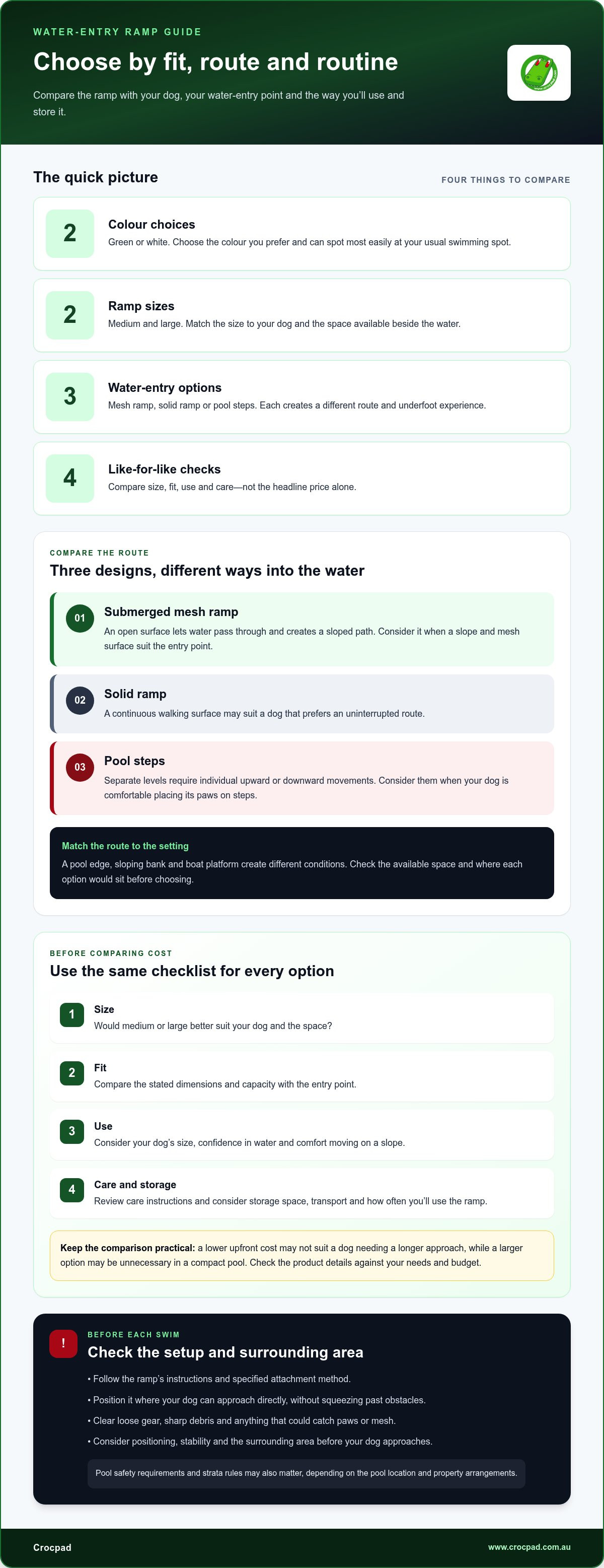
Colour choices are simple: submerged mesh dog ramps for easy water entry are available in green and white. Choose the colour you prefer and that’s easiest to spot at your usual swimming spot.
It’s natural to weigh cost alongside colour when choosing a ramp for your dog. You want a clear view of the options and a practical way to assess what matters for your dog’s water access.
This guide explains the available colours and what to consider when comparing cost and suitability, including your dog’s size, confidence in water and usual entry point. These practical checks can help you choose equipment that fits your water outings.
Key Takeaways
- Compare the ramp’s listed cost with the features and suitability that matter for your dog, rather than judging by price alone.
- Green and white are the available colour choices; consider which is easiest to see against your usual swimming spot.
- Learn how ramp designs differ from solid ramps and pool steps, and what to consider for your setting.
- Use gradual, positive training to help your dog approach and use a water-entry ramp with confidence.
- Review positioning, stability and the surrounding area before each swim to help spot potential hazards.
Product price
Compare the purchase cost with what the ramp needs to do at your swimming spot. A lower upfront figure may not suit a dog that needs a longer approach, while a larger option may be unnecessary in a compact pool. Start with your dog’s size, confidence in water and usual entry point. Then assess whether the ramp’s dimensions and stated capacity match those needs.
Crocpad’s dog ramp is available in medium and large sizes, with green and white colour options. To choose the right size, consider the space beside the water, the distance from the edge to the entry point and how your dog moves on a sloped surface. Check the listed capacity and product features as well as the price.
Build a like-for-like comparison before deciding. Use the same checklist for each option, rather than comparing a headline price with an incomplete product description:
- Size: Check whether medium or large better suits your dog and available space.
- Fit: Compare the ramp’s stated dimensions with the pool or water access point.
- Use: Consider whether your dog can approach and climb the ramp comfortably.
- Care: Review any care or storage instructions provided with the product.
Think beyond the initial purchase. A ramp used at a backyard pool may need different storage arrangements from one taken to a lake. Storage space, transport and how often you’ll use it all affect its practical value over time. Keep these ownership considerations separate from the listed price so your comparison reflects your routine.
Australian pool safety requirements and strata rules may also be relevant, depending on the pool’s location and property arrangements. Consider them separately: pool requirements relate to the setting, while strata by-laws may affect shared property or its use.
Before buying, note your dog’s size, the entry point and where you’ll store the ramp. Compare these details with the product description and the medium and large options. Choose the colour, green or white, that you prefer and can spot easily in the setting. This helps you weigh price against fit, intended use and storage rather than choosing on colour or cost alone.
Treat that figure as the purchase cost to weigh against the fit and use you have already assessed, rather than as proof that the ramp will suit every swimming spot. Before committing, confirm that the product description matches your dog’s needs and the available space, and consider whether the amount fits your budget.
If you are comparing options, use the same criteria for each and keep practical factors such as storage and transport distinct from the listed price. A clear comparison can help you decide whether the purchase cost is worthwhile for your routine. If any product details needed to judge suitability are unclear, check them before buying rather than relying on price alone.
How do submerged mesh dog ramps compare with solid dog ramps and pool steps?
Compare the options by the route your dog needs to take from land into water. A mesh ramp creates a sloped path, a solid ramp has a continuous surface, and pool steps provide separate levels. A dog hesitant to step down may respond differently to a slope than to individual steps. Start with your dog’s movement, confidence and usual entry point.
Mesh is open, allowing water to pass through, while a solid ramp has an uninterrupted walking surface. The textures may feel different underfoot. If your dog is wary of unfamiliar surfaces, observe how it approaches a mat, grate or other textured surface at home. That can help you decide which design may feel more familiar.
A solid ramp may suit a dog that prefers a continuous surface, while mesh offers a different underfoot feel. Neither description alone confirms grip or stability, which depend on the specific product, its condition and positioning. Check the product information for surface details, then consider the approach: a sloping bank, pool wall and boat platform each create different conditions. A dog entering from a low lake edge may face different obstacles from one stepping down beside a pool.
- Mesh ramp: Consider it when a sloped route and an open surface suit the entry point.
- Solid ramp: Compare it when your dog prefers a continuous walking surface.
- Pool steps: Consider them when your dog can confidently place its paws on separate levels.
- Entry layout: Match the route to the pool edge, bank or platform your dog uses.
Pool steps may take up less space along the approach, but each step requires a separate upward or downward movement. A ramp spreads that movement along a slope. This can matter for dogs that hesitate at raised edges or have difficulty with individual steps. Measure the route and check where each option would sit before choosing. Neither a ramp nor steps suit every dog or pool.
Make the decision practical. Compare surface feel, approach angle, available space and your dog’s comfort with the movement involved. Then introduce the chosen access route calmly, allowing your dog to investigate before entering the water. If you’re exploring equipment for active days around water, browse water recreation gear as part of your planning.
How do you install and secure a submerged mesh dog ramp?
Start with the ramp’s instructions, the water’s edge and the surface where it will rest. Setup varies by design, so use only the attachment points and method specified for that ramp. A pool wall, lakeside bank and boat platform each present different conditions. Before setup, clear loose gear, sharp debris and anything that could catch paws or mesh.
Work through this setup sequence before letting your dog approach:
- Choose the entry point. Position the ramp where your dog can approach directly, without squeezing past furniture or other obstacles.
- Read the instructions. Identify the correct orientation, assembly steps and any specified attachment method.
- Inspect the ramp. Look over the mesh, seams, frame and attachment points for visible damage or loose parts.
- Set the ramp in place. Follow the product’s directions for the intended pool, lake or platform setting.
- Secure it as directed. Use the specified fittings only. Don’t improvise with rope, weights or pool fittings unless the instructions allow them.
- Test before use. Apply gentle pressure by hand and watch for shifting, tipping or movement at the water’s edge.
Check the route from both ends. Keep the landward approach clear and position the water end as the instructions specify. A ramp beside a pool ladder, for example, could leave too little room for your dog to walk straight on. Move nearby toys and chairs, and make sure the ramp doesn’t block another access point. Keep people out of the water while you set it up and check its position.
A submerged position doesn’t guarantee stability. Water movement, a sloping bank or contact with a pool wall can affect how the ramp rests. If it shifts during a hand test, stop and reposition it according to its directions. Don’t let your dog approach an unstable setup. Don’t tie the ramp to a fence, ladder or other structure unless the manufacturer specifically permits it.
Before each swim, inspect the mesh and connections, confirm the ramp is positioned as directed and clear the approach. After use, follow the supplied care and storage instructions. If moving it from a pool to a lake, reassess the ground, water’s edge and attachment method instead of assuming the previous setup still applies. Keep the instructions handy, and don’t use the ramp if damage or movement makes it unsuitable.
How do you train a dog to use a water-entry ramp?
Train your dog in calm, manageable steps, beginning with the ramp dry and securely positioned. Choose a quiet, familiar place where your dog can approach without distractions. Keep treats nearby and let your dog investigate at its own pace. Build familiarity with the ramp before introducing water, movement or the excitement of a swim.
Keep practice sessions short and reward relaxed behaviour. For example, reward your dog for looking at the ramp, sniffing it or placing one paw on it. If your dog backs away, pause and give it space. Don’t pull, push or lure your dog onto the surface. Letting your dog approach voluntarily helps avoid creating a negative association with the ramp.
- Introduce the ramp on land. Let your dog inspect it while it’s stable and dry. Reward calm curiosity.
- Practise approaching. Stand beside the ramp and invite your dog towards it with a familiar cue or treat.
- Reward each small step. Praise looking, sniffing and stepping onto the surface, even if your dog doesn’t cross it.
- Build a full crossing. Once your dog is comfortable, encourage walking across the ramp on land.
- Add the water setting. Position the ramp securely as instructed, then let your dog explore from the shore or pool edge.
- Practise entry and exit. Reward your dog for using the ramp in both directions, without rushing the approach.
Keep the first water practice quiet and familiar. Avoid combining ramp training with a busy pool, splashing children or an unfamiliar lake. If your dog already knows a cue such as “come” or “touch”, use it consistently at the ramp entrance. Reward the action you want, such as walking up the slope, rather than calling repeatedly while your dog hesitates.
Watch your dog’s body language during each attempt. A tucked tail, retreating or refusing treats can signal that the next step feels too challenging. Return to a familiar stage, such as approaching the dry ramp, and finish on a calm interaction. Never use swimming as a consequence or force your dog into the water. Each dog learns at its own pace, so repeat the easiest comfortable step before progressing.
End practice while your dog is settled, then repeat the same sequence another time. Keep the ramp in the same position during early sessions to make the route familiar. Once your dog can walk across confidently, practise approaching from the direction it will use at the pool or lake. Always supervise your dog near water, even after it learns the route.
Are submerged mesh dog ramps safe for dogs, and what hazards should owners check
A submerged mesh ramp can provide a route between land and water, but safety depends on the setup, condition and dog using it. Inspect the ramp before each swim and watch your dog throughout. Even a ramp that looks secure can shift if a dog approaches from the side. Mesh construction alone doesn’t make an entry point safe or suitable.
Start by checking the ramp. Look for tears, loose edges or anything in the mesh that could catch a claw. Inspect seams, frame parts and attachment points for damage or movement. Follow the product instructions for setup, use and care. If a connection looks worn or the ramp won’t stay positioned as directed, keep your dog away until the issue is resolved.
Check the approach and surrounding water before your dog enters. Remove hazards such as sharp debris, loose pool toys and tangled lines. Look for slippery ground, a steep bank or nearby obstacles that could block the route. At a pool, ensure the ramp doesn’t block another access point. At a lake, consider changing water movement and an uneven shoreline.
- Position: Check that the ramp stays where the instructions direct, without tipping or sliding.
- Surface: Look for damage, loose material or debris caught in the mesh.
- Route: Clear the approach and exit of obstacles, cords and sharp objects.
- Dog’s condition: Consider your dog’s comfort, confidence and ability to use the route.
- Supervision: Stay close enough to respond if your dog struggles or leaves the ramp.
Water conditions matter. A calm backyard pool differs from a lake with waves, a current or an unstable bank. Choose a setting where you can keep the ramp in place and see your dog clearly. Don’t encourage entry if visibility is poor or water movement makes the ramp shift. Reassess after rain or changing conditions instead of relying on yesterday’s setup.
Match the ramp to your individual dog. A nervous dog may need gradual training before using it, while an older or less mobile dog may struggle with the approach. Stop if your dog slips, panics, tires or avoids the ramp. A ramp is an access aid, not a substitute for supervision or for choosing a suitable swimming environment.
Make inspection part of your swim routine: check the ramp, clear the route and stay attentive while your dog uses it. Explore dog water-access equipment to find an option suited to your water activities.
When identifying equipment for a safety check, keep the product name and its identifier together. The Crocpad Inflatable Dog Ramps have the SKU 53156. This can help distinguish that item when checking its instructions or discussing a concern with the seller; don’t assume another ramp has the same setup or use requirements.
Assess the ramp in the conditions where your dog will use it. If it shifts, shows damage or can’t be positioned as directed, pause the swim and resolve the issue before your dog approaches. Supervise closely throughout: a ramp doesn’t remove the need to monitor your dog in or near water.
Crocpad: Floating Water Mat
Crocpad’s Floating Water Mat offers a separate way to enjoy time on the water, alongside your dog’s ramp routine. It is made from marine-grade XPE foam, requires no inflation and comes in three sizes. Keep its purpose distinct: the mat isn’t a dog ramp or a supervised route into the water. Never tow it behind a boat or other watercraft, and don’t jump onto it. Keep it away from sharp objects, which can scruff or tear the foam.
Choose equipment according to the activity you have in mind. A ramp supports water access, while a floating mat is for recreational use on the water. For a closer look at Crocpad’s water recreation products, visit Crocpad’s website.
Make water days work for your dog
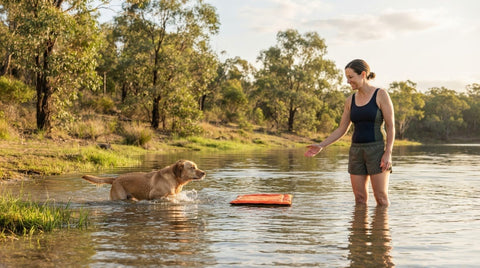
Choose a water-entry setup that suits your dog’s confidence and the places you swim. A submerged mesh dog ramp for easy water entry can be part of a thoughtful routine, alongside patient practice and close supervision. Focus on making each visit comfortable rather than rushing towards a perfect swim.
For days spent enjoying the water beyond the ramp, Crocpad also offers a Floating Water Mat, the Minima Pool Slide and the Megalo 3M Inflatable Water Pool Slide. Each brings a different kind of recreation to pool or lake time, so consider what suits your household’s plans.
If you’re ready to explore a ramp for your dog, take the next step and contact Crocpad about ramp options. Build a setup that helps your dog approach the water at their own pace, and enjoy more confident days together.
Frequently Asked Questions
What is a submerged mesh dog ramp and how does it work?
A submerged mesh dog ramp for easy water entry is a sloped route from land into the water, with an open mesh surface. It gives a dog a continuous path to walk up or down instead of separate steps. Position and secure the ramp as its instructions direct, then let your dog get used to the surface gradually. Stay close and supervise every water session.
How much do submerged mesh dog ramps cost in Australia?
For a submerged mesh dog ramp for easy water entry, compare the ramp’s size and stated capacity with your dog and intended use. The M ramp holds up to 45 kg; the L holds up to 65 kg. Both use drop-stitch technology for a rigid structure.
How do you clean and maintain a mesh dog ramp in pool or salt water?
After use, follow the ramp’s care and storage directions. Before each swim, inspect the mesh, seams, frame and attachment points for damage or loose parts.