
Dog ramps
2 articles in Blog
Crocpad’s Dog ramps articles — safe water access for dogs, around pools, boats and docks.
You will find training steps for a dog that has never used a ramp, how to position one so it is found in a panic rather than a calm moment, sizing for breed and weight, and what changes on a boat versus a backyard pool.

What’s covered in Dog ramps
- Submerged Mesh Dog Ramp Cost and Colour Choices — Compare submerged mesh dog ramp for easy water entry colours and cost, with practical advice on visibility, suitability, safe setup and training your dog.
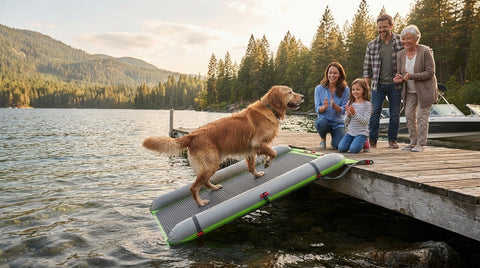
- Portable Dog Ramp for Lake Jetty Water Access: Buying Guide — Find the best portable dog ramp for lake dock water access. Compare styles, jetty layouts, and safety tips to choose the right Crocpad ramp for your pet.
About dog ramps and water safety for pets
Introduce a ramp in shallow, boring conditions and build up. Most dogs need a few short sessions to trust a surface that moves slightly underfoot, and forcing a nervous dog onto it early teaches exactly the wrong lesson. Grip, width and angle do the work: too steep and a heavy or older dog cannot climb it, too narrow and they step off the side. On a boat or dock, add the movement of the water and the ramp has to stay put under a scrambling animal — fixing points are not optional there.
Dog ramps: common questions
How do I train my dog to use a ramp?
Start dry and shallow, lead them up and down with treats, keep the sessions short, and never push a nervous dog. Repeat it as the normal exit route for a week or two so it is habit before it is ever needed in an emergency.
Where should the ramp go?
Where your dog naturally gets in, or as close to it as the pool shape allows. A dog in difficulty swims the edge near its entry point, so a ramp on the opposite side is unlikely to be found.