

The safer choice may be the feature your pool can properly accommodate, not the one that looks less risky. A useful pool slide vs diving board safety comparison starts with your pool’s layout and water conditions, then considers how people will use the feature.
It’s understandable to worry about falls, collisions and unsafe entries, especially when children are swimming. Slides and diving boards bring different hazards, and neither is automatically the safer option for every backyard pool. Both also need clear rules and attentive supervision.
This guide compares the risks, pool suitability and supervision needs of each feature. You’ll learn what to assess, from a slide’s access and landing areas to a diving board’s water depth and clear space. You’ll also see why it’s important to follow product instructions and check the setup before use. By considering the risks and how your household will use the feature, you can choose an option that fits your pool and set practical safety rules.
Key Takeaways
- A pool slide vs diving board safety comparison starts with your pool’s layout and water conditions, not the assumption that one feature is always safer.
- Compare how each feature directs water entry, and check the space available for use and landing.
- Consider who will use the feature, their experience and the supervision you can provide before choosing.
- For an inflatable slide, check pool suitability and follow the product’s instructions. Don’t assume it works like permanent pool equipment.
- Use the four checks in this guide, pool fit, users, supervision and manufacturer guidance, to weigh your options.
Pool slide vs diving board safety: what are you really comparing?
Neither a pool slide nor a diving board is automatically safer in every pool. A slide guides a person down a surface and into the water. A diving board lets a person jump or dive from a raised platform. These different movements create different risks, and the pool, users, behaviour and supervision all affect whether either feature is suitable.
A useful pool slide vs diving board safety comparison starts with how people will enter the water, then checks whether the pool and household can support that activity.
For a visual comparison, watch this video:
How does a pool slide differ from a diving board?
Sliding usually means travelling down a set path before entering the water. Jumping and diving involve launching from a board, with the user controlling their movement through the air. Neither entry is risk-free. Slides can involve slips, collisions and unsuitable landings. With diving, a swimmer may strike the pool bottom or side if the depth or clearance doesn’t suit the entry.
Inflatable slides and fixed pool structures aren’t interchangeable. An inflatable model has its own setup and use instructions, so don’t assume checks for permanent equipment apply in the same way.
Why does the pool matter as much as the feature?
Before choosing, check the available water depth and clear space against current, relevant guidance and the manufacturer’s instructions. Look for pool edges, steps, walls and other obstructions near the likely entry area. Consider nearby swimmers too: someone entering the water can collide with a person already swimming, particularly when the pool is busy.
General swimming pool safety information also highlights why water depth matters for diving. Use an appropriate, current source for specific suitability guidance rather than relying on a general comparison or guesswork.
- Entry: A slide guides the descent; a board enables a jump or dive.
- Hazards: Consider slips, collisions and landing risks for slides, and entry depth and clearance for diving.
- Suitability: Check the pool layout, intended users, behaviour, supervision and product instructions.
The practical answer is simple: suitability, behaviour and supervision all affect safety. A pool that can’t accommodate the intended entry safely, or a household that can’t manage the activity responsibly, may not be right for that feature.
Pool slide safety: assess the landing area, setup and users
A slide’s route into the water is only part of the safety check. Look at the whole path, including the steps or climbing area, surrounding deck, exit point and space swimmers need to clear after entering. A wet or crowded deck can increase the chance of slips. A person landing near the pool edge, an obstruction or another swimmer may be at risk of impact.
These checks matter in a pool slide vs diving board safety comparison because slides and boards create different movement patterns. For a slide, focus on the route and landing zone. Don’t assume guidance for fixed pool equipment applies to an inflatable slide.
What should you check before using a pool slide?
Start with the product instructions. Confirm the required setup, securement method, permitted use and any stated pool suitability conditions. Then check that the landing area and surrounding deck are clear, and that the route into the water doesn’t direct users towards an edge or into the path of swimmers. Don’t guess at suitable depth or clearance. Use the specific product guidance.
If the slide shifts, appears unstable or conditions around the pool make entry unsafe, stop using it and reassess before anyone climbs on. An inflatable slide has product specific setup needs, so treat its instructions as essential rather than relying on assumptions about permanent structures.
Who needs closer supervision around a pool slide?
Children and inexperienced swimmers may need active adult supervision. Keep attention on the slide and water rather than other distractions. Waiting users can crowd the access point. Pushing, climbing together or entering before the landing area is clear can lead to collisions. Set simple turn taking rules and make sure each person waits until the previous user has moved clear.
- Check the path: Keep the deck and landing zone clear of obstructions and other swimmers.
- Check the instructions: Follow the manufacturer’s setup, securement and use guidance.
- Manage turns: Allow one user at a time where the product instructions require it, and prevent pushing or crowding.
For a broader comparison of how equipment guidance can differ, SwimRight Academy explains how to compare installation and safety standards. Use it as a starting point, then follow the instructions for the specific slide you’re considering.
If an inflatable slide seems suitable for your pool, you can explore Crocpad’s inflatable pool slides. Choosing a product doesn’t replace checking your pool, following its instructions or supervising swimmers.
Diving board safety: compare entry risks and pool suitability
A diving board changes how a swimmer enters the water. The user takes off from a raised platform and chooses a jump or dive, so their direction, body position and landing depend on their actions. That differs from a slide, which guides a person down a set path. Diving risks centre on take off, flight and landing; slide risks centre on descent and exit. Neither entry is risk-free, and a diving board doesn’t make a pool suitable for every dive.
What makes a diving board entry different?
With a jump or dive, the swimmer needs enough depth and clear space for the intended movement. If another person is in that area, an entry can lead to a collision. Set a clear rule that the board is used only when the landing area is clear, and discourage behaviour that could send a swimmer off course.
Risk depends on more than the board itself. A pool’s depth profile, shape and surrounding space affect whether a particular type of entry is appropriate. Don’t assume a pool suited to a straight jump is also suitable for a head first dive.
What pool checks matter before choosing a diving board?
Check compatibility with the board manufacturer and seek advice from a qualified pool professional who can assess the pool. Ask about water depth across the entry area, the pool’s slope, clear space for entry and exit, and nearby walls, steps or other obstacles. Consider the conditions and intended use too: assess the specific dives users plan to attempt rather than treating a board as approval for every kind of entry.
Avoid relying on a general depth figure as a universal rule. Check current official guidance for applicable federal, state and local requirements, and ask a pool professional to help assess compatibility if needed. The U.S. Safety Standard for Swimming Pool Slides concerns slides, so it shouldn’t be used to establish diving board suitability or requirements for boards.
Before deciding, get clear answers to these questions:
- Pool compatibility: Does the manufacturer’s guidance match your pool’s depth profile and shape?
- Clearance: Is the intended entry area free of people and obstructions, with a clear way to exit?
- Intended use: Does the pool suit the jumps or dives household members plan to make?
- Local guidance: Have you checked current official sources for requirements that may apply to your pool and board?
If you can’t confirm the pool is suitable for the intended use, don’t assume that adding a board makes it safe. Have compatibility checked before choosing, and keep the board out of use until you have reliable guidance.
How to compare a pool slide and diving board for your household
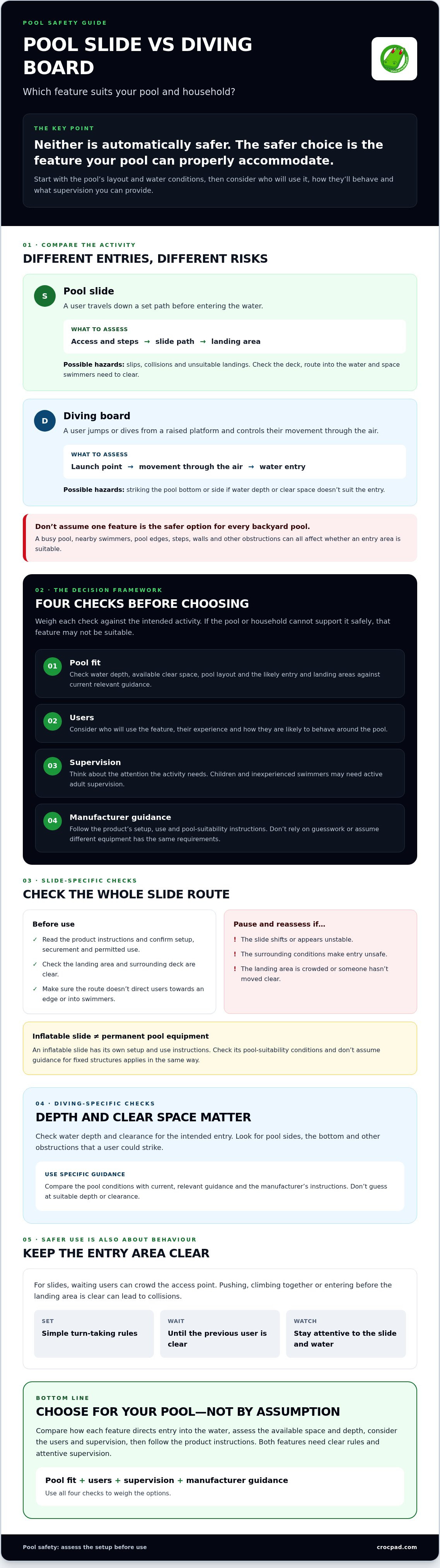
Make the decision through four checks, not by comparing the features in isolation. A slide guides users along a set descent, while a diving board enables a jump or dive. Consider which activity your household will actually use, then assess whether the pool, users and supervision arrangements suit it. If either option can’t meet verified suitability guidance, rule it out.
Which questions should you ask about your pool?
Start with the pool itself. Note its shape and layout, available clearance, water depth information and any nearby walls, steps or other obstructions. Get depth details from reliable records or advice from a qualified pool professional rather than estimating by eye. Check that there’s a clear route into and out of the water instead of assuming one is available.
Next, list the intended users. Consider their swimming ability, confidence and experience with the activity, including differences across the household. Check current official federal, state and local guidance for any pool safety requirements that may apply, and compare your pool information with the manufacturer’s instructions for the specific feature. A board or slide can’t make an unsuitable pool suitable.
How should you compare supervision and household rules?
Choose the activity your household can manage responsibly, not just the one that looks most exciting. Consider whether users understand the feature’s instructions and can follow them consistently. Plan for an attentive adult to actively supervise. Signs and agreed rules can support safe behaviour, but they don’t replace watching swimmers.
Keep the rules simple: agree on where users wait, how they enter and how they exit. Make sure the landing or entry area is clear before the next person goes. If users have different abilities, set expectations that account for the least confident swimmer rather than assuming everyone will use the feature in the same way.
Check the pool, intended users, active supervision and manufacturer guidance before choosing.
- Pool: Can its layout, water conditions and clearance suit the feature?
- Users: Does the activity match their abilities and experience?
- Supervision: Can an adult actively watch and manage turns?
- Guidance: Do the manufacturer’s instructions and current official advice support the intended use?
This is the practical heart of a pool slide vs diving board safety comparison: choose only an option that fits both the pool and the people using it. If you’re considering an inflatable slide, explore Crocpad’s inflatable pool slides, then check the specific product instructions and pool suitability before use.
Choosing a pool slide: make safety checks part of the fun
The right choice depends on what your pool can safely accommodate and how your household will use it. A diving board may suit a pool only when its depth, clearance and layout meet verified guidance for the intended jumps or dives. An inflatable slide may be worth considering if its product instructions and your pool conditions support its intended use. Neither feature is suitable by default, and neither should be chosen on excitement alone.
When might an inflatable pool slide be worth considering?
Consider a slide if users want a guided descent into the water and there’s suitable space for the setup, entry and landing area. Check the current information and instructions for the specific product, then compare them with your pool layout and conditions. Don’t assume an inflatable slide has the same setup requirements as fixed pool equipment, or that it will suit your pool without checking.
Crocpad sells the Minima Pool Slide, Mikros Pool Slide and Megalo 3M Inflatable Water Pool Slide. These are product options to assess, not a substitute for confirming pool suitability. Crocpad doesn’t provide on site installation or build pools, so establish compatibility and arrange any pool or setup advice separately where needed.
What should you do before adding either feature?
Before choosing a slide or board, gather reliable information about your pool’s depth and layout. Check the relevant manufacturer guidance, current official safety information and, if needed, advice from a suitable pool professional. Make sure there’s clear space for entry and exit, and consider how nearby swimmers, obstacles and the household’s experience affect use.
Plan supervision and household rules before the first swim. Decide who will actively watch, how users will take turns and how the entry or landing area will be kept clear. Explain the rules in plain language, and don’t rely on signs or reminders instead of attentive supervision. If you can’t confirm that the pool suits the feature and intended activity, pause the decision rather than hoping the setup will be fine.
- Check the pool: Confirm layout, water conditions, clearance and compatibility.
- Check the users: Match the activity to their abilities and experience.
- Check the guidance: Follow current product instructions and verify relevant safety advice.
- Plan supervision: Set clear turn taking and entry rules before use.
A careful pool slide vs diving board safety comparison can help you choose a feature that fits your pool and household, or decide that neither is suitable. If you’re considering an inflatable slide, explore Crocpad’s inflatable pool slide range and review the current product details and instructions before deciding.
Choose the feature that fits your pool
The right choice isn’t decided by the feature alone. A slide and a diving board create different ways to enter the water, so check your pool’s layout, depth and clear space against relevant guidance and product instructions. Then consider who will use the feature, how they’ll behave and whether an adult can actively supervise.
That’s the heart of a practical pool slide vs diving board safety comparison: pool suitability comes first, followed by realistic household rules. If you can’t confirm an option is suitable for your pool and intended use, pause before choosing.
Crocpad’s confirmed inflatable slide range includes the Minima Pool Slide, Mikros Pool Slide and Megalo 3M Inflatable Water Pool Slide. Explore the range and review current product details and instructions before deciding: explore Crocpad inflatable pool slides.
With the right checks and clear expectations, you can make an informed choice and enjoy your pool time with care.
Frequently Asked Questions
Is a pool slide safer than a diving board?
Neither feature is automatically safer for every pool or household. A slide guides a user down a set path, while a diving board enables a jump or dive, so the risks and suitability checks differ. Consider your pool’s layout and water conditions, the intended users, their behaviour and the supervision available. If you can’t confirm a feature suits your pool and intended use, don’t proceed on assumption alone.
Can you put a pool slide in any swimming pool?
No. A slide needs to suit the particular pool, and its setup and use must follow the manufacturer’s instructions. Check the available space, landing area, water conditions and possible obstructions against the product guidance. Inflatable slides have specific product instructions, so don’t assume they can be set up like fixed pool equipment. If suitability isn’t clear, seek reliable advice before using the slide.
What is the main safety difference between a pool slide and a diving board?
The main difference is how users enter the water. A slide guides a person along a descent, so checks include the route, landing area and possible crowding. A diving board lets a user launch into a jump or dive, making the intended entry, water depth and clearance important considerations. Both can involve collisions if another swimmer is in the entry area, so keep it clear and supervise use.
How deep does a pool need to be for a slide or diving board?
There isn’t one depth that can be recommended for every slide, board, pool or intended entry. For a slide, check the specific product instructions for pool suitability and water conditions. For a diving board, confirm the pool’s depth profile and intended use against current manufacturer guidance, official information and advice from a suitable pool professional. Don’t estimate depth or rely on a general figure as proof that your pool is suitable.
Can children use a pool slide or diving board safely?
Children may use a slide or diving board only when the feature, pool and intended activity are suitable, and the product guidance is followed. Arrange active adult supervision, particularly for children who are still gaining swimming confidence. Set clear rules for waiting, taking turns and keeping the entry or landing area clear. Don’t treat signs or rules as a substitute for an adult watching swimmers and responding to changing conditions.
What should I check before using an inflatable pool slide?
Read the instructions for the specific slide and confirm its setup, securement and permitted use. Check that your pool suits the product guidance and that the route, landing area and surrounding deck are clear of people and obstructions. Don’t use the slide if it appears unstable or conditions seem unsuitable. Crocpad sells inflatable slides including the Minima, Mikros and Megalo 3M, but product choice doesn’t replace these checks.
Do local pool safety regulations apply to slides and diving boards in the US?
Requirements can depend on where you live and the details of the pool and feature, so don’t assume one rule applies everywhere or that slide and diving board requirements are identical. Check current information from your local municipal or state government and consult the product manufacturer. If pool compatibility or an applicable requirement is unclear, seek advice from an appropriate pool professional before choosing or using either feature.


