

What does a “non-slip” label tell you about a slide once it’s wet? Not enough on its own. The surface, pool-edge setup and space beyond the landing point all affect whether a slide is a suitable fit. Choosing a non slip pool slide for inground pools means checking the product details against your pool, not relying on a traction claim or product photos alone.
It’s reasonable to want confident footing and a slide that suits your pool. Look for clear information about the surface and construction, then compare the slide’s dimensions and setup requirements with your layout. Measure the intended placement and landing area, and follow the manufacturer’s instructions. If important details are missing, ask before buying rather than making assumptions.
This guide explains what to verify, how to assess pool fit and setup, and how to compare Crocpad’s Minima Pool Slide, Mikros Pool Slide and Megalo 3M Inflatable Water Pool Slide without assuming they share the same features. Use the checks below to weigh traction, space and product information before choosing a slide for your backyard.
Key Takeaways
- Treat “non-slip” as a claim to check, not a guarantee of secure footing on a wet surface.
- Separate product specifications from seller claims, and note which details still need confirmation.
- Compare the Minima Pool Slide, Mikros Pool Slide and Megalo 3M Inflatable Water Pool Slide against your pool layout without assuming their features are the same.
- Measure the pool edge and landing area, then check each model’s setup instructions and compatibility before buying.
- Choose a non slip pool slide for inground pools only after checking its traction information, pool fit and setup requirements.
What Does Non-Slip Mean for Inground Pool Slides?
A “non-slip” label sounds reassuring, but it doesn’t explain how a slide feels underfoot when wet. Treat it as a claim to investigate, not a promise that slipping can’t happen. Footing can vary with water on the surface, the surface’s condition, a user’s movement and whether the slide is set up as instructed.
A non-slip claim may point to a traction feature, but it can’t guarantee secure footing in every wet condition or setup. When comparing a non slip pool slide for inground pools, look for specific supporting information rather than relying on the label alone.
For a general buying-guide perspective on pool slides, watch this video:
How to assess a non-slip claim without guessing
Start with the manufacturer’s product information. Does it name a traction feature, say where it is on the slide and explain the conditions it is intended for? If not, ask the seller for clarification or supporting documentation. General statements about durability don’t establish grip, and product photos can’t show how a surface performs when wet.
The coefficient of friction describes friction between surfaces. A reference to friction alone doesn’t confirm how a particular inflatable surface performs when wet. Check whether any evidence applies to the actual slide surface and the conditions in which you plan to use it.
Why wet conditions change the buying question
Consider the slide’s separate contact areas. Climbing access is where a user’s feet and hands meet the slide; the sliding surface has different contact and movement; pool entry is the transition into the water. A feature described for one area doesn’t tell you how another area performs.
Water and surface condition can affect footing, as can movement and setup. Check the maker’s instructions for placement and use, and don’t assume a grip claim applies in every condition. Maintain active supervision. Traction information can help you compare products, but it doesn’t replace watching users or following the manufacturer’s guidance.
How to Compare Pool Slide Grip, Construction and Inground-Pool Fit
A useful comparison separates what product documentation confirms from what a seller claims and what you still need to check. A traction phrase or polished photo can’t replace dimensions, setup instructions or evidence about the surface. For each model, note the details you can verify, then follow up on gaps before deciding.
| What to compare | Verified in product documentation | Seller claim to check | Still needs confirmation |
|---|---|---|---|
| Traction | A clearly described feature and where it appears | “Non-slip” or “grippy” wording | Which conditions the claim covers and whether supporting evidence is available |
| Construction | Stated materials and construction details | General durability language | Any detail not described in the product information |
| Pool fit and setup | Dimensions and stated setup instructions | Broad claims that it suits inground pools | Compatibility with your pool edge, placement and landing area |
| Use details | Any explicitly stated capacity, age guidance or included accessories | Implied suitability based on photos or marketing copy | Anything not confirmed for that model |
Assess each area separately: climbing access, the slide surface, pool-edge placement and the landing area raise different questions. For example, a traction feature described for climbing access doesn’t establish how the sliding surface performs. If you’re reviewing US product documentation, the CPSC Safety Standard for Swimming Pool Slides is a reference for that market. A mention of compliance isn’t proof of every feature or of suitability for your specific pool.
Which slide specifications should buyers compare?
Check the exact model’s stated dimensions, construction and setup requirements in the manufacturer’s information. Look for an explicit description of any traction feature, including where it is located. Don’t infer weight capacity, age suitability or included accessories from appearance or broad promotional wording. If a detail affects your decision and isn’t documented, ask the seller to confirm it.
Will an inflatable slide suit your inground pool?
Measure the intended placement area, pool edge and clear landing space. Compare those measurements with the product’s documented dimensions and setup guidance. Pool geometry matters: a listed slide size alone won’t establish whether its placement and exit suit your layout. Check what support or edge arrangement the maker specifies. If fit information is missing, confirm it with Crocpad before buying. You can review Crocpad’s inflatable pool slides as options to investigate, while checking each model’s details individually.
Which Crocpad Inflatable Slide Might Suit Your Pool Setup?
Crocpad’s inflatable slide range includes the Minima Pool Slide, Mikros Pool Slide and Megalo 3M Inflatable Water Pool Slide. The product names give you options to investigate, but aren’t enough to rank the slides for grip, fit or safety. Compare the current details for each model, then match its documented requirements to your pool measurements and intended use.
Compare the Minima, Mikros and Megalo 3M using verified details
The information in this guide confirms the product names, but doesn’t provide model-specific dimensions, construction, setup instructions or traction evidence. Use the table as a prompt when checking each model’s current product page. Treat any item as unconfirmed until the product information or Crocpad confirms it.
| Model | Verified here | Check on the current product page or confirm directly |
|---|---|---|
| Minima Pool Slide | Product name | Dimensions, construction, setup, pool-edge compatibility, intended use and any documented traction feature |
| Mikros Pool Slide | Product name | Dimensions, construction, setup, pool-edge compatibility, intended use and any documented traction feature |
| Megalo 3M Inflatable Water Pool Slide | Product name | Dimensions, construction, setup, pool-edge compatibility, intended use and any documented traction feature |
Don’t infer that one model is larger, grippier or better suited to a particular pool from its name. Look for explicit details about the climbing area, slide surface and how the product is positioned at the pool edge. If a page uses terms such as “grip” or “durable” without explaining what they refer to, ask which feature is meant and whether supporting information is available. The Pool & Hot Tub Alliance provides broader pool-industry context, but can’t confirm the specifications of an individual slide.
Match a slide to your pool and intended use
Start with your layout. Note the available deck space, the shape and position of the pool edge, and the clear area where a user would enter the water. Compare those measurements with the exact model’s documented dimensions and setup guidance. Check the manufacturer’s stated use recommendations for the people who will use the slide, rather than assuming suitability from photos or general descriptions.
If the product page doesn’t explain how a model fits your pool edge, what setup it requires or whether it has a documented traction feature, seek confirmation from Crocpad before deciding. You can’t assess a non slip pool slide for inground pools responsibly without checking the model specifications against measurements of the intended setup area.
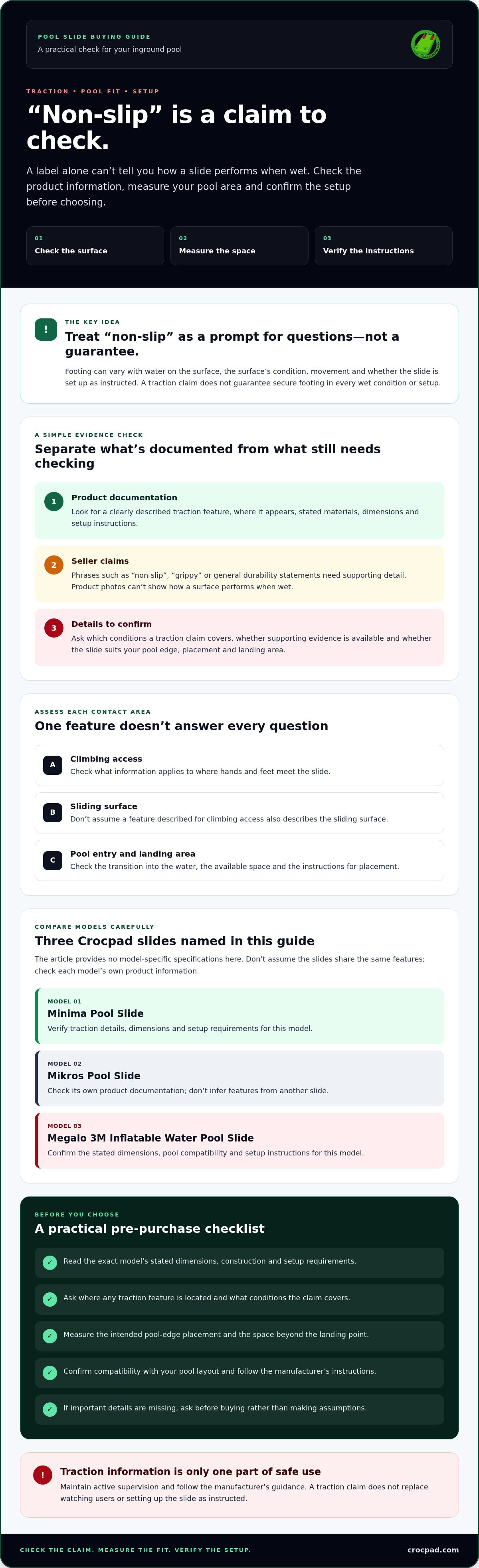
A Pre-Purchase Checklist for a Non Slip Pool Slide for Inground Pools
Before choosing a non slip pool slide for inground pools, work through these checks in order. They help you identify missing information before buying and avoid discovering that a product’s requirements don’t match your pool layout.
What to measure and confirm before ordering
- 1. Map the setup area. Measure the space where you plan to place the slide, including the pool edge and the clear area beyond the intended exit. Note anything that could affect placement or access.
- 2. Check the exact model’s dimensions. Compare your measurements with the current product information for that model. Don’t estimate fit from a photo or assume similarly named models have the same dimensions.
- 3. Review pool-edge requirements. Read the manufacturer’s setup guidance for how the slide should sit at the edge and what support or placement it requires. If the instructions don’t address your pool layout, ask for clarification.
- 4. Verify the traction claim. Ask what feature is intended to provide grip, where it is located and what information supports the claim. Check whether it applies to climbing access, the sliding surface or another area.
- 5. Confirm other decision-critical details. Check the model’s stated use guidance and relevant specifications, such as capacity or included components, rather than assuming these from general descriptions. Ask Crocpad to clarify missing dimensions, compatibility or traction details before purchase.
How to plan a responsible poolside setup
Once you’ve found a model that appears to fit, follow the manufacturer’s setup and use instructions. Keep access to the slide clear, and make sure the intended landing area is free of people and obstacles before use. Planning where users climb, slide and enter the water helps you assess the whole setup, not just the product’s footprint.
Maintain active adult supervision while the slide is in use. Recheck the setup if it shifts, and stop use if conditions change or you can’t maintain the arrangement described in the instructions. A traction claim doesn’t replace supervision or confirm that the slide suits every pool.
Before deciding, compare your measurements with the current information for the specific model and resolve any unanswered questions. Review Crocpad’s inflatable pool slide information as a starting point, then confirm the details you need for your pool before ordering.
Choose an Inflatable Pool Slide with Verified Fit and Grip Information
A confident choice comes from matching product information to your pool, not relying on a “non-slip” label alone. Before settling on a non slip pool slide for inground pools, check the traction information for the exact model, compare its documented specifications with your measurements, and make sure you understand its setup requirements. If an important detail is missing, pause and ask instead of filling the gap with an assumption.
Questions to ask before choosing a model
Use these questions to guide your final comparison. Keep the answers with the product information so you can assess models on the same basis:
- What traction information applies to this exact model? Ask what feature is described, where it is on the slide and whether the manufacturer provides supporting details for wet use.
- Will it suit my pool edge and available space? Confirm the model’s current dimensions, pool-edge compatibility and setup instructions. Measure the intended placement and landing area, then compare them with the documented requirements.
- What use conditions and supervision guidance does the manufacturer specify? Read the model’s instructions and check that your planned use and supervision arrangements are consistent with them.
These checks help distinguish a documented feature from broad marketing language. They also show what still needs an answer before you commit. If the product description doesn’t address your pool layout or the traction claim, don’t treat it as confirmation that the slide is suitable.
Explore Crocpad’s confirmed inflatable slide range
Crocpad’s options include the Minima Pool Slide, Mikros Pool Slide and Megalo 3M Inflatable Water Pool Slide. Their names alone don’t establish dimensions, setup needs or grip performance, and the information here doesn’t verify model-specific traction features. Check the current product details for the model you’re considering, and follow up on unanswered questions about fit, use or safety before selecting it.
Compare the verified information, check it against your pool measurements, and choose only when the setup and product details make sense for your situation. Explore Crocpad’s inflatable pool slides and review the current model information as you weigh up your options.
Make Your Pool Slide Choice with Confidence
A confident choice starts with evidence, not a “non-slip” label. Check the exact model’s traction information, compare its documented specifications with your pool measurements, and clarify unanswered setup questions before buying.
Crocpad offers the Minima Pool Slide, Mikros Pool Slide and Megalo 3M Inflatable Water Pool Slide as options to investigate. Don’t assume their features are alike, or treat any model as a proven non-slip solution without supporting product information. For a non slip pool slide for inground pools, suitability depends on verified details and how they match your setup.
Take time to check first so you have a clearer picture of your options. Review the current details for each model and choose based on your pool’s measurements and the product’s stated requirements.
Frequently Asked Questions
Is an inflatable pool slide suitable for an inground pool?
An inflatable pool slide may suit an inground pool if the specific model is intended for that use and its setup requirements match your pool. Check current product information for dimensions, pool-edge placement and any stated water or support requirements. Inflatable construction alone doesn’t confirm compatibility. If those details aren’t clear, ask the seller before buying rather than assuming the slide will fit.
Are inflatable pool slides genuinely non-slip when wet?
Not necessarily. A “non-slip” description doesn’t guarantee secure footing in every wet condition. Water, surface condition, movement and setup can all affect grip. Check whether the manufacturer describes a specific traction feature, where it appears and what evidence supports the claim for wet use. Don’t rely on product photos or general durability language as proof, and remember that a grip claim doesn’t replace active supervision.
How do I check whether a pool slide will fit my inground pool?
Measure the planned placement area, pool edge and clear landing space, then compare those measurements with the exact model’s current product specifications. Read the setup instructions for placement or support requirements. Don’t estimate dimensions from photos or assume models with similar names share the same measurements. If compatibility with your pool edge or layout isn’t explained, ask the seller to confirm before ordering.
Can I use an inflatable slide with any inground pool?
No. Pool shapes, edges and available surrounding space vary, and each slide may have its own setup requirements. Check the specific model’s stated use, dimensions and instructions against your pool layout, including the intended entry and landing area. If product information doesn’t confirm compatibility with your setup, don’t assume it will work. Contact the seller for clarification before choosing a model.
What should I look for in a non-slip pool slide?
For a non slip pool slide for inground pools, look for a clearly described traction feature and confirm which area it applies to, such as climbing access or the slide surface. Check whether the manufacturer provides supporting details for wet conditions. Also compare documented dimensions, construction and setup requirements with your pool measurements. Treat broad “non-slip” wording as a claim to verify, not a guarantee of secure footing.
Are Crocpad’s Minima, Mikros and Megalo 3M slides non-slip?
The information here doesn’t confirm documented traction features for the Minima Pool Slide, Mikros Pool Slide or Megalo 3M Inflatable Water Pool Slide. Don’t assume any model is non-slip based on its name or appearance. Check each model’s current product information for specific grip details, and ask Crocpad to clarify anything that isn’t documented. Verify dimensions and setup requirements separately before deciding whether a model suits your pool.
What safety steps should I take before using an inflatable pool slide?
Read and follow the manufacturer’s setup and use instructions for the exact model. Check that the slide is positioned as directed, access is clear and the intended landing area is free of people and obstacles. Provide active adult supervision throughout use. Recheck the setup if it shifts or conditions change, and stop using the slide if you can’t maintain the arrangement described in the instructions.


