A ladder isn’t the only way for your dog to get out of the pool. A pool ladder alternative for swimming dogs is a ramp that offers a more gradual route from the water to the edge. A homemade floating ramp is one option, but it must suit your dog’s weight and stay stable as they climb.
It makes sense to look beyond a standard ladder: narrow rungs can be awkward for dogs, while a secure, gradual exit can make pool time easier to manage. The right setup depends on your dog and your pool, so prioritise fit and stability over appearance.
This guide explains how to assess ramp capacity, make a simple floating option with a mat and pool noodles, and decide whether a ramp, ladder or another entry point suits your pool. It also covers practical safety considerations for planning a more reliable route in and out of the water.
Key Takeaways
- Choose a ramp that stays stable under your dog’s weight, and assess how its size and setup suit your pool.
- A homemade floating ramp can be assembled from a rubber mat, pool noodles and zip ties, then secured to the poolside.
- Check the pool’s edge, access point and surrounding space before deciding whether a ladder or ramp is practical.
- A shallow, gradual entry can be easier for dogs to use; supervise swimming and keep early pool sessions short.
- Explore Crocpad’s Floating Water Mat as a floating pool option, while assessing separately whether it provides a suitable entry and exit for your dog.
1. Adjusting the ramp for a dog's weight
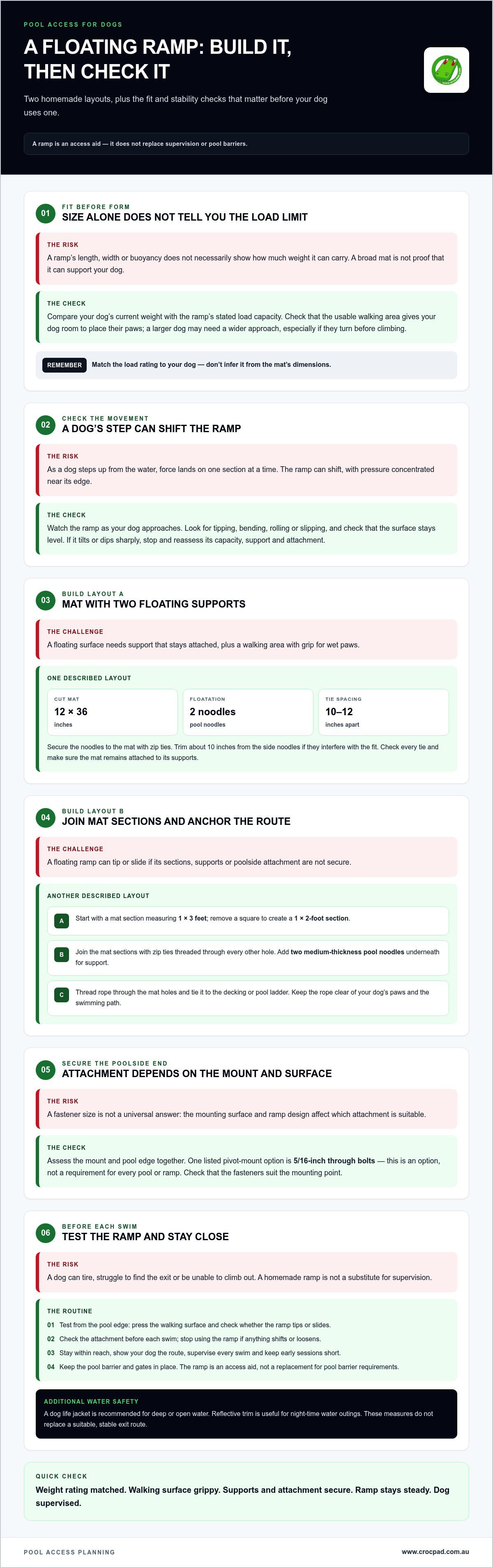
Start with your dog’s current weight and compare it with the ramp’s stated load capacity. Don’t assume a ramp’s length, width or buoyancy indicates its load limit. Those dimensions describe its size, not necessarily how it performs when a dog climbs aboard.
Consider how your dog will use the ramp, not just their weight while standing still. As a dog steps from the water, force lands on one section at a time, which can shift the ramp and concentrate pressure near its edge. Check that the surface stays level as your dog approaches, and watch for bending, rolling or slipping. If the ramp tilts or dips sharply, stop and reassess its capacity, support and attachment.
Use the pool’s layout to judge where extra stability matters. A pivot mount can let a ramp move with the water, but its fasteners must suit the mounting point. One listed option is 5/16-inch through bolts for securing a pivot mount. That measurement applies to the bolt option, not to a universal requirement for every pool or ramp. The mounting surface and ramp design affect which attachment is appropriate.
A commercial rubber mat measuring 36 by 36 inches can provide a broad surface for an entry setup. However, its square footprint alone doesn’t establish that it can carry your dog. Match the ramp’s actual load rating to your dog’s weight, and check that the usable walking area gives them room to place their paws. A large dog may need a wider approach than a small dog, especially if they turn before climbing.
- Compare: Match your dog’s weight with the ramp’s stated capacity before use.
- Observe: Watch for tipping, flexing or sliding as your dog approaches.
- Secure: Assess the mount and pool edge together, rather than choosing bolts by size alone.
Introduce the ramp gradually. Keep your dog’s first pool sessions short, supervise every swim and let them approach at their own pace. A dog life jacket is recommended for deep or open water, and reflective trim is useful for night-time water outings. These measures support swimming, but they don’t replace a ramp that suits your dog’s weight or a stable exit route.
Age matters alongside weight. A ramp may be easier on an older dog’s joints, so consider whether it provides a manageable way to enter and leave the pool. The goal is not just to find a ramp that supports the stated load, but one your dog can use comfortably.
When comparing options, assess a dog pool ramp for stability, size and ease of setup. Consider these qualities together: a suitable size does not guarantee stability, and simple setup does not replace a secure fit. Choose an arrangement that matches your dog’s weight and the pool’s mounting area, then observe your dog using it under supervision.
2. Homemade floating pool ramp for dogs
Don’t assume pool safety laws require a dog-specific ramp. A ramp is an access aid, not a replacement for the pool barrier requirements that apply to your property. Plan your dog’s exit separately, and keep the pool barrier and gates in place.
A DIY ramp needs secure attachment, support for your dog and a walking surface with grip. A textured rubber mat can help wet paws hold their footing, while smooth plastic or a loose mat can slip or shift. Check for sharp edges after cutting, and ensure ties have no loose ends where paws could catch.
For one floating design, cut a rubber mat to 12 by 36 inches and use two pool noodles as flotation supports. Secure the noodles to the mat with zip ties spaced every 10 to 12 inches. Trim about 10 inches from the side noodles if they interfere with the fit. Before your dog uses it, check that every tie holds and the mat remains attached to its supports.
Another layout starts with a mat section measuring 1 by 3 feet. Remove a square to create a 1-by-2-foot section, then join the mat sections with zip ties threaded through every other hole. Add two medium-thickness pool noodles underneath for support. To secure the ramp, thread rope through the mat holes and tie it to the decking or pool ladder. Keep the rope clear of the dog’s paws and the swimming path.
Dogs can use floating ramps, but a homemade version’s stability depends on its flotation and anchoring. Test it from the pool edge before use. Press the walking surface, check whether the ramp tips or slides, and make sure it stays within reach of the poolside. Take care with floating stairs on pool ledges, where an unstable landing can make entry difficult.
A dog can tire, struggle to find the exit or be unable to climb out, so supervision is essential. Stay within reach, show your dog the route and keep early swims short. Check the ramp and its attachment before each swim, and stop using it if any section shifts or loosens. A homemade structure is an access aid, not a substitute for supervision.
- Grip: Use a textured rubber walking surface.
- Floatation: Secure two pool noodles with zip ties every 10 to 12 inches.
- Attachment: Tie rope through the mat holes to the decking or pool ladder.
If a ready-made dog-access option better suits your pool, explore Crocpad’s pool and dog-water equipment.
3. Dog pool ladder selection
For many dogs, a ramp is easier than steps because it provides a gradual route from the water. Steps may suit a confident dog that can place its paws on separate, stable treads. A ramp can be gentler on an older dog’s joints. Choose based on your dog’s movement and the pool’s edge.
In Australia, dog pool ramp and step prices vary according to design, materials, size and attachment method. Compare those features and the load capacity rather than relying on price alone.
Start by measuring the space between the water and the landing point. A ramp needs a clear approach and enough room to meet the pool edge without a sharp change in level. For steps, check that each tread offers your dog a stable place to stand. A narrow or steep route can be difficult to navigate, even if the structure fits the pool.
Match the structure to your dog’s size and confidence. A large dog needs a walking surface that supports their weight and provides secure footing. A hesitant swimmer may need a gradual incline and a familiar route, rather than steps that require separate jumps. Consider how your dog turns and approaches the pool, not just the equipment’s dimensions.
Choose an escape platform if your dog needs a clear place to pause before climbing out. It should meet the ramp or steps without shifting, leaving a gap or creating an awkward transition. Keep the route clear, and make sure the entry point is accessible from the water. A platform that moves under your dog’s paws can undermine an otherwise suitable ramp.
Position the ramp or steps at a consistent pool entry point, and secure them according to their design. Press down at the water-facing end to check for movement, tipping or separation from the edge. Then guide your dog towards it while staying close, and observe whether they can find and use the route. Adjust the position if they struggle to reach the first step or ramp surface.
- Ramp: Consider a gradual surface for older dogs or dogs uncomfortable with steps.
- Steps: Choose stable treads if your dog can climb them confidently.
- Platform: Check that the landing joins the exit route without a gap or wobble.
Pool location and ladder suitability
Start at the spot your dog already approaches, then trace the route from the water to the pool surround. An inground pool with wide coping has a different landing from an above-ground pool with a narrow top edge. Check that a ramp can meet the edge without a sharp lip, awkward gap or unstable overhang. The best position gives your dog a visible, direct way out.
Assess the surface beside the pool next. Timber decking, paving and grass each affect how a ramp or ladder can be placed and secured. A sloping or slippery landing can make even a well-positioned exit difficult to use. Clear loose toys and furniture from the approach, then look for a firm, level place where your dog can step off safely.
A fixed pool ladder may be convenient for people, but its narrow rungs and upright shape can be awkward for a dog. Watch how your dog approaches the existing access point. If they paw at the ladder or struggle to lift their body onto a rung, consider a ramp with a gradual approach. Pool ladders aren’t designed for dogs, so provide an exit they can use.
For a floating ramp, check where it will sit in relation to the pool wall, coping and decking. If it drifts away from the edge, a gap can form; if it catches on the coping, it may tilt as your dog climbs. Secure the attachment to a suitable point and test the full route from the water. Check for movement at the edge and underfoot before your dog approaches.
Pool ledges can look like an easy rest point, but floating stairs on a ledge need particular care. Your dog needs a stable transition from the water onto the ledge, then a clear path to dry ground. If a step rocks, slides or leaves your dog stranded on a narrow surface, choose another arrangement. Avoid using cement blocks as an improvised entry without expert advice.
Walk the route from your dog’s perspective. Check visibility, approach space, surface grip and the final landing. A corner beside a fence may restrict turning, while a clear side of the pool can allow a straighter climb. Keep the exit point consistent during training, and remove obstacles that could block access while your dog is swimming.
- Pool edge: Match the ramp’s landing to the coping or wall shape.
- Surround: Choose a firm, level area with a clear approach.
- Stability: Test for drifting, rocking and gaps before swimming.
Reassess the setup whenever pool furniture moves or the ramp changes position. A suitable pool ladder alternative for swimming dogs must work with the pool’s edge and surrounding space, not just the equipment itself. Keep the access route open and supervise your dog every time they swim.
5. What are the safest alternatives to a pool ladder for dogs in Australia?
A pool ladder is designed for people, so it may not give a dog a practical way out. A stable, shallow, gradual entry is generally easiest for a dog to use independently. Choose a setup to suit your pool’s edge, your dog’s size and how confidently they move through water.
A gradual ramp provides a continuous surface from the water towards the pool surround. It can help dogs that find separate ladder rungs difficult, including older dogs whose joints may benefit from a less abrupt climb. Check the walking surface, support and landing together. If the ramp shifts or leaves a gap at the edge, it won’t provide a dependable route.
A floating ramp or platform can suit a pool without a fixed shallow entry. Its usefulness depends on staying in position as your dog approaches and climbs. Consider water movement, the attachment point and the space at the poolside. A platform can offer a pause before the final climb, but it needs a clear connection to the exit rather than leaving your dog on an isolated surface.
A shallow shelf or beach-style entry gives a dog a gradual transition if the pool already has one. Assess the slope and surface from your dog’s perspective. The entry should lead to an accessible route out, not just a place to stand in the water. If the pool has a steep drop immediately beyond the shelf, work out how your dog will continue towards dry ground.
Compare options using the same practical checks. Can your dog reach the entry from the water? Does the route suit their size and movement? Does the structure remain stable, and can you set it up without blocking the poolside? A compact exit may suit a small dog but feel restrictive for a larger one. Ease of setup matters too, as an awkward arrangement can be harder to position consistently.
Don’t improvise an entry from cement blocks. Their placement and stability can create hazards, so consult an expert before using them for dog-pool access. A secure, purpose-planned route is a better starting point than stacking blocks beside the water.
Once you’ve identified which access style fits your pool, explore pool recreation options as you plan your setup.
- Best starting point: A stable, shallow, gradual entry.
- For a ramp: Assess its support, position and landing as one route.
- For a ledge: Ensure it connects clearly to the way out.
Focus on your dog’s complete route rather than assuming a human ladder is enough because it reaches the poolside. Pool ladders are not designed for dogs, so they need a suitable way to enter and exit the pool. Assess an alternative in both directions: access into the water and a usable way back out. If an arrangement does not provide both, it is not a complete solution. Choose an access option that addresses the full route.
Crocpad: Floating Water Mat
Crocpad’s Floating Water Mat adds a floating platform for poolside recreation, but it isn’t automatically a dog-exit ramp. Consider it when you want a place to lounge on the water, and assess separately whether your dog can safely enter and leave the pool. Do not tow a floating mat behind a boat or any watercraft. A mat should not replace a stable, accessible exit route or active supervision.
For dog access, consider how the mat sits against your pool edge, whether it stays in position and whether your dog can manage the transition. If you need a purpose-made option for water access, Crocpad also offers Inflatable Dog Ramps. Match your choice to your pool layout and your dog’s needs.
Explore Crocpad’s water recreation products, or visit Crocpad to find an option that suits your setup.
Make your pool setup work for every swimmer
Choosing a pool ladder alternative for swimming dogs is also a chance to plan how your pool works for the whole household. Keep your dog’s exit route clear and practical, while treating floating play equipment as a separate part of pool time. Crocpad offers a Floating Water Mat, Minima Pool Slide and Megalo 3M Inflatable Water Pool Slide for recreation; these products don’t replace a suitable dog exit.
Consider how you use the pool, where your dog enters and what helps them leave the water confidently. A well-planned setup can support more relaxed time together, while keeping swimming access distinct from leisure equipment.
Contact Crocpad to discuss your needs and explore options for your pool. Make a thoughtful choice, then enjoy a more considered poolside routine with your dog.
Frequently Asked Questions
Which pool ramps are suitable for dogs of different sizes and breeds?
Choose by your dog’s weight and body size, rather than breed alone, as dogs within one breed can vary. Crocpad’s Inflatable Dog Ramp comes in size M, with a 45 kg capacity and dimensions of 120 cm long by 80 cm wide, and size L, with a 65 kg capacity and dimensions of 150 cm long by 100 cm wide. Check your dog fits within both the weight limit and usable ramp space.