

A safe sandbar raft-up starts with boats, not a floating mat. If you're figuring out how to tie up raft for boat sandbar party, plan for wakes, wind and the possibility of hulls moving against each other. A relaxed gathering depends on choosing a suitable spot, agreeing on the approach and communicating clearly before anyone moves between boats.
This guide covers a cautious boat-to-boat setup, from checking the space and coordinating an arrival sequence to using fenders, lines and anchors for their separate purposes. You’ll also learn when to pause or break up the raft if conditions change. A Crocpad Floating Water Mat can be part of the day as a separate recreational float, but it must never be towed behind a boat or used to connect boats. With a little planning, your crew can focus on the sandbar and good company.
Key Takeaways
- Plan roles, communication and weather checks before approaching the sandbar, so everyone knows how the raft-up will be managed.
- Learn how to tie up raft for boat sandbar party with a cautious sequence that keeps positioning and vessel-specific judgement front of mind.
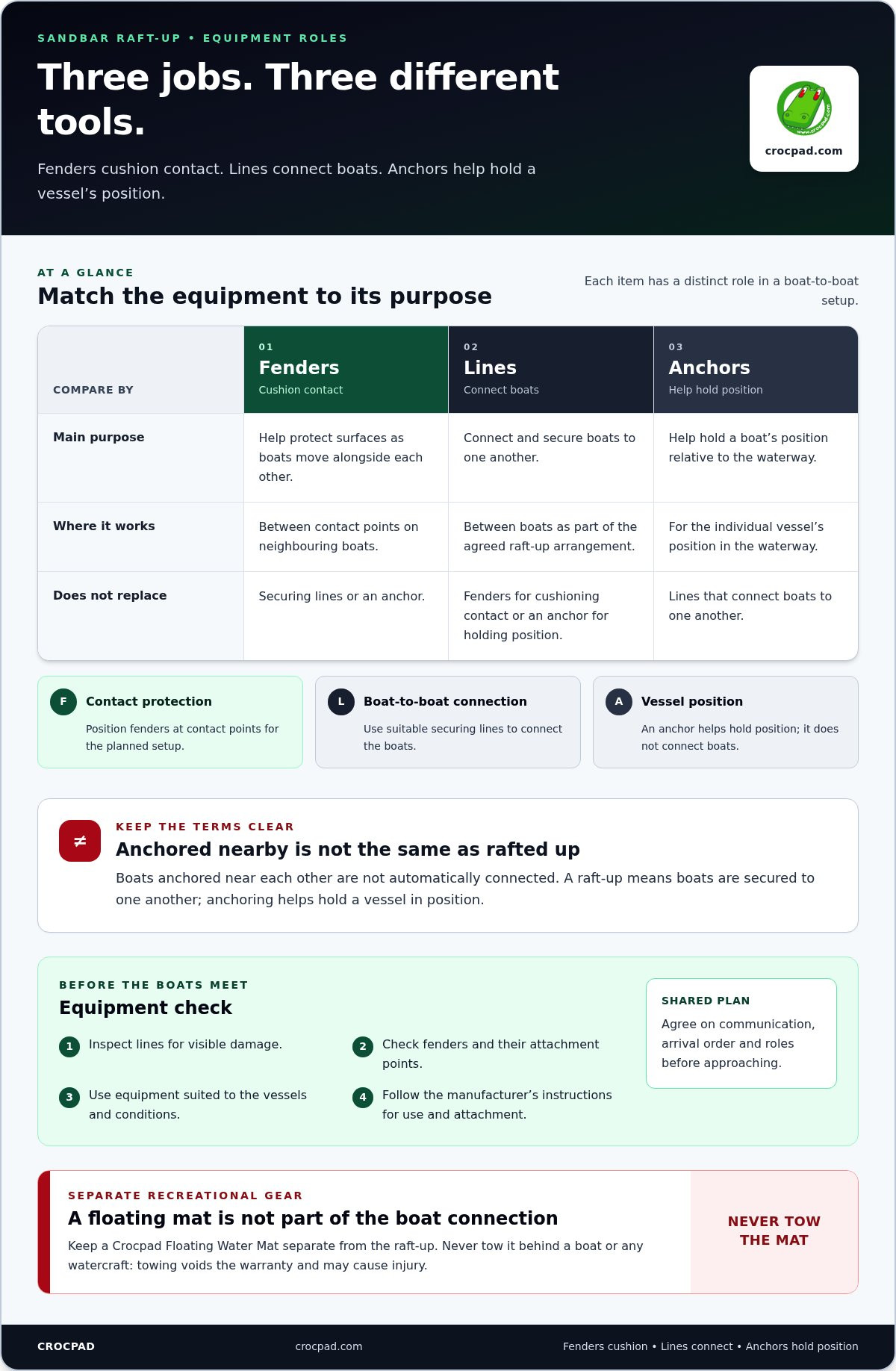
- Fenders cushion contact, securing lines connect boats, and anchors help hold a vessel’s position. One does not replace another.
- Use a Crocpad Floating Water Mat as separate recreational gear, never as a towable part of the boat-to-boat setup.
- Keep a Crocpad floating mat untowed: towing it behind a boat or any watercraft voids the warranty and may cause injury.
What a boat raft-up means at a sandbar party, and what to plan first
A boat raft-up is a group of boats secured to one another so people can gather between or aboard them. “Raft-up” and “tie-up” are often used for this arrangement. It differs from boats anchoring separately in the same area: being nearby does not mean the boats are connected. Before deciding how to tie up raft for boat sandbar party, agree on the plan while everyone still has room to manoeuvre.
A sandbar may feel like an easygoing destination, but available space, nearby traffic and changing conditions all affect the approach. Confirm which boats are joining, how they’ll arrive and how operators will communicate. A raft-up is also distinct from a floating recreational mat. A mat is not a boat, a towable accessory or a point for attaching lines. For general background on the term, see What is a Raft?
Here’s a video of a sandbar tie-up to help visualise the kind of gathering being discussed:
Raft-up, tie-up and anchoring: what each term means
People often use “raft-up” and “tie-up” interchangeably for boats secured together. Anchoring is different: an anchor helps hold a boat in position relative to the waterway, while lines connect boats to one another. Boats anchored near each other are not automatically a raft-up. Keeping the terms distinct helps everyone understand whether vessels are connected or positioned separately.
Plan any floating mat separately. It’s recreational gear, not part of the raft-up and not a point for attaching tow lines.
Why a sandbar gathering needs a plan before arrival
Choose a lead communicator to share the agreed arrival sequence and pass on updates. This helps keep instructions consistent, but each skipper remains responsible for their own vessel and manoeuvring decisions. Agree on a simple way to pause or change the plan if conditions no longer suit the approach.
Before setting out, talk through:
- Who’s participating: confirm which boats are joining and who is coordinating communication.
- Conditions and space: assess the weather, available room and nearby water traffic. Reconsider the plan if any of these change.
- Arrival sequence: agree which boat moves first and how the others will approach. Avoid having several boats manoeuvre into position at once.
- Protective gear: have suitable fenders and securing lines ready for the planned arrangement.
Preparation can’t make every setup risk-free, but it gives the group a shared starting point. If a skipper judges that the conditions or space aren’t suitable, they can choose not to join or change their vessel’s plan.
How to prepare the boats, people and gear for a safe raft-up
Prepare before the boats meet. Agree on communication, arrival order and roles while the vessels are still travelling separately. Check the forecast and keep monitoring conditions. If wind, chop, visibility or traffic changes the situation, pause and reassess instead of pressing on with the original plan.
Pre-departure checklist: agree how operators will communicate, choose an arrival order and lead communicator, review weather and water conditions, check each vessel’s readiness and accessible safety gear, and inspect suitable lines, fenders and anchoring equipment according to their instructions.
Agree on communication and arrival order
Operators should agree how they’ll pass instructions before approaching one another. Choose a method everyone can use from their vessel and keep messages short and clear. Identify who will guide the sequence, while remembering that each skipper makes decisions for their own boat and can pause or opt out if the approach no longer feels suitable.
Set an arrival order that gives each operator room and time to manoeuvre without competing instructions. Passengers should know where to sit or stand during the approach and who, if anyone, is handling lines. Keep people clear of line-handling unless they understand their task. Don’t turn a social guest into an improvised deckhand during a hurried manoeuvre.
Prepare lines, fenders and boat protection
Lines, fenders and anchors have different jobs. Lines connect and secure boats to one another. Fenders sit between contact points to help protect surfaces as boats move alongside each other. Anchoring helps hold a boat’s position relative to the waterway, but doesn’t connect boats or replace securing lines. Choose an arrangement that suits the vessels and conditions rather than treating one item as a substitute for another.
Before departure, inspect lines for visible damage and check that fenders and their attachment points are ready for the planned setup. Use equipment suited to the vessels and follow the manufacturer’s instructions for use and attachment. Don’t assume that a line, cleat or other fitting is suitable just because it’s available on board. If equipment is damaged or its intended use is unclear, don’t build the plan around it.
Check each boat’s readiness for the trip, including its operating systems and required safety gear. Make sure the operator knows who is aboard and that passengers understand the basic plan. Anyone working out how to tie up raft for boat sandbar party should agree on a shared process while leaving every skipper in control of their own vessel.
Once the boat plan is organised, a separate recreational float can complement the gathering. Explore Crocpad floating water mats as an option for the party, not as part of the boat-to-boat connection.
Fenders, lines or anchors: compare what each does in a raft-up
These three types of equipment serve distinct purposes. Fenders help cushion contact between neighbouring boats, lines secure boats together, and an anchor helps hold a vessel’s position relative to the waterway. A considered raft-up plan accounts for each role separately rather than expecting one item to do everything.
Guides from MISSION and AERÉ include fenders and lines among raft-up equipment. The practical distinction is what each item does, where it fits into the arrangement and what it can’t do. Use this comparison as a starting point, then choose equipment to suit the vessels and conditions.
| Equipment | Role | Placement context | Limitation |
|---|---|---|---|
| Fenders | Help protect contact areas between boats. | Between neighbouring vessels where contact may occur. | They don’t secure boats together or eliminate movement. |
| Securing lines | Connect boats to form the raft-up. | Between suitable attachment points on the vessels. | They don’t cushion contact or hold the group in place by themselves. |
| Anchor | Helps hold a vessel’s position relative to the waterway. | As part of a vessel’s anchoring setup, considered separately from the boat-to-boat tie-up. | It doesn’t connect boats or replace securing lines. |
Fenders reduce contact between neighbouring boats
Position fenders between surfaces that could meet as the boats move alongside one another. Fenders provide a buffer at contact points, but they don’t lock boats in place or guarantee that hulls won’t touch. Check their placement as the arrangement settles, and reassess if positions or conditions change. Having fenders aboard doesn’t mean every possible contact area is protected.
Lines and anchors have different jobs
Securing lines connect the vessels; an anchor is a separate consideration for holding position. The appropriate approach depends on vessel setup and conditions, so there’s no universal anchor plan for every raft-up. Follow equipment instructions and use attachment points appropriate to the vessel. A line can’t replace an anchor, and an anchor can’t replace the lines joining boats.
Fenders help cushion contact between boats; securing lines connect the boats together. That distinction matters when you tie up raft for boat sandbar party, because movement, spacing and vessel arrangement can change. Treat the gear as a coordinated setup, not as a set of interchangeable fixes. If the boats shift, check whether fenders still cover likely contact areas and whether the arrangement remains suitable. If not, pause and reassess instead of relying on extra tension or misplaced gear to solve the problem.
How to tie up boats for a sandbar party: a cautious step-by-step approach
A raft-up should come together through deliberate coordination, not a race to claim a spot. Use the sequence below as general guidance, not as a substitute for each skipper’s vessel-specific judgement, equipment instructions or awareness of conditions. If the setup stops feeling controlled, pause or change the plan.
- Agree on the plan. Before approaching, confirm the arrival order, how operators will communicate and who will guide the manoeuvre. Make sure passengers know what to expect and stay clear of boat-handling tasks unless they understand their role.
- Assess the conditions and space. Look at available room, nearby water traffic, wind, wakes and other conditions affecting the approach. Consider whether the vessels can manoeuvre without crowding other boats or creating an uncomfortable situation. If conditions have changed since the group agreed to meet, discuss whether to proceed.
- Approach cautiously. Have boats move into position in the agreed sequence, with operators communicating clearly. Avoid rushing or assuming what another skipper intends. If communication breaks down, spacing becomes awkward or anyone is uncomfortable, stop the approach and regroup before continuing.
- Protect likely contact points. Before boats are secured alongside one another, position suitable fenders between areas where contact may occur. Fenders can help protect surfaces, but don’t stop boats moving. Keep passengers aware of the space between vessels and away from places where boats could press together.
- Secure and keep checking. Use suitable lines at appropriate attachment points, following equipment instructions and the needs of the vessels. Don’t rely on fenders to connect boats or on securing lines to cushion contact. Once joined, watch how the boats move as people shift and conditions change. Adjust or end the arrangement if it no longer feels controlled or safe.
Approach and position boats deliberately
Good communication matters throughout the manoeuvre, not just before it starts. Operators should make their intentions clear and allow time to respond. Passengers can help by staying attentive and following agreed directions, rather than moving between boats during the approach. If the group can’t maintain clear communication or suitable spacing, pause and reassess instead of forcing the tie-up.
Secure the raft-up and keep monitoring conditions
There isn’t one line arrangement or anchor method that suits every combination of boats and conditions. Skippers should judge what’s appropriate for their own vessels, use equipment as directed and remain ready to adjust the arrangement. Wind, wakes or people moving can change how boats sit together, so a setup that seemed comfortable at first may need attention later.
If you’re adding a separate recreational float to the gathering, explore Crocpad floating water mats as another way to enjoy time on the water.
Add a floating mat to the party without towing it behind a boat
A floating mat can provide a separate place to relax at a sandbar gathering, but it isn’t part of the boat-to-boat raft-up. Boats are secured to one another using suitable lines; a recreational mat is used separately. Keep those roles distinct as you plan how to tie up raft for boat sandbar party. Don’t treat a mat as a connection point, towable accessory or substitute for boat equipment.
Never tow a Crocpad floating mat behind a boat or any watercraft. Towing voids the warranty and may cause injury. There are no exceptions to this instruction. Keep the mat separate from the boats and follow its product instructions and stated safety limits for use. Don’t attach it to a boat or use a boat to pull or drag it.
Keep the floating mat separate from the raft-up
The raft-up is the arrangement of boats secured together. The floating mat is recreational gear for use separately from that arrangement. Treating them as two distinct parts of the gathering helps prevent confusion over what lines are for and avoids turning the mat into a tow point. Before the party, make sure everyone understands this separation, especially anyone helping handle gear or organise activities on the water.
Plan where the mat fits into the day without making it part of the boat manoeuvre. Follow the mat’s instructions and safety limits, and keep its use separate from the work of positioning or securing vessels. This keeps the raft-up plan focused on boats and their equipment, while the mat remains a standalone recreational float.
Choose a mat size for the planned gathering
Crocpad Floating Water Mats are available in 18 ft/5.5 m, 12 ft/3.65 m and 6.5 ft/2 m sizes. To choose a size, consider the space available for using the mat and how you plan to use it. Allow for the surroundings and other activities at the gathering instead of choosing on size alone. These dimensions describe the mats, not how many people they can hold.
Keep the boats’ layout and the mat’s separate recreational use in mind as you organise the day. A considered choice helps you plan the space without confusing a floating mat with a boat-to-boat tie-up.
For a separate float at your gathering, Explore Crocpad Floating Water Mats. Compare the available sizes and choose one that suits the space and intended use, then follow its instructions and never tow it behind a boat or watercraft.
View Crocpad Floating Water Mats for the available size options.
Make your next sandbar outing one to look forward to
Give your group time to coordinate before the next day on the water. A shared plan helps everyone arrive with the same expectations and makes it easier to adapt if conditions or available space change. Keep the focus on a relaxed gathering, with each skipper making considered choices for their own vessel.
If you’re planning a tie up raft for boat sandbar party outing, consider what would make the day enjoyable beyond time spent on the boats. A separate recreational float can offer another way to enjoy the water, provided it stays separate from the raft-up and is used according to its instructions.
Explore Crocpad Floating Water Mats and choose a mat for your next gathering. Plan thoughtfully, keep safety in view and enjoy your day on the water.
Frequently Asked Questions
Can I tow a floating mat behind my boat to a sandbar party?
No. Crocpad floating mats aren’t towables. Never tow one behind a boat or any watercraft. Towing voids the warranty and may cause injury. Keep the mat separate from the boat during travel and use, and follow its product instructions. Plan its place in the gathering independently of the boats’ movements.
What is the difference between a raft-up and anchoring near other boats?
A raft-up connects boats to one another; anchoring nearby doesn’t. For example, two boats can occupy the same area while each remains separately positioned. Don’t assume a nearby boat is connected or will move in coordination with yours. Make your intentions clear to its operator.
Do fenders stop boats from moving during a raft-up?
No. Fenders cushion contact; they don’t hold boats in place. If a fender shifts as the vessels move, reassess its position and the arrangement rather than treating it as a restraint. Passengers should avoid placing hands or feet between boats, where changing gaps can create a hazard.
How many lines do you need to tie boats together?
There’s no universal line count for every combination of boats. The suitable arrangement depends on the vessels, attachment points, equipment and conditions. Follow the lines’ instructions and use attachment points appropriate to your boat. If you can’t establish a setup you’re confident is suitable, don’t improvise a fixed number based on someone else’s arrangement.
Is it safe to raft up at a sandbar when it is windy or wakes are passing?
Don’t assume conditions are suitable simply because the boats were manageable earlier. Wind and passing wakes can affect how they move, so assess what’s happening at the time. If spacing or communication becomes difficult, pause the manoeuvre or adjust the plan. Each skipper should decide whether to continue with their own vessel.
Can a floating mat be part of a sandbar party?
Yes, as a separate recreational float rather than a connection between vessels. Plan its use independently of boat positioning and follow the mat’s product instructions. Keeping the float and raft-up as separate parts of the gathering helps avoid confusion between recreational gear and equipment used to manage the boats.


