

What if the green film on your floating mat isn’t a sign that the lake needs treating? After a day on the water, algae, fine debris and other residue can leave a mat looking less than fresh. Knowing how to prevent algae growth on lake floating mat surfaces starts with separating mat care from lake management: you can clean material from your mat, but that won’t control algae in the water.
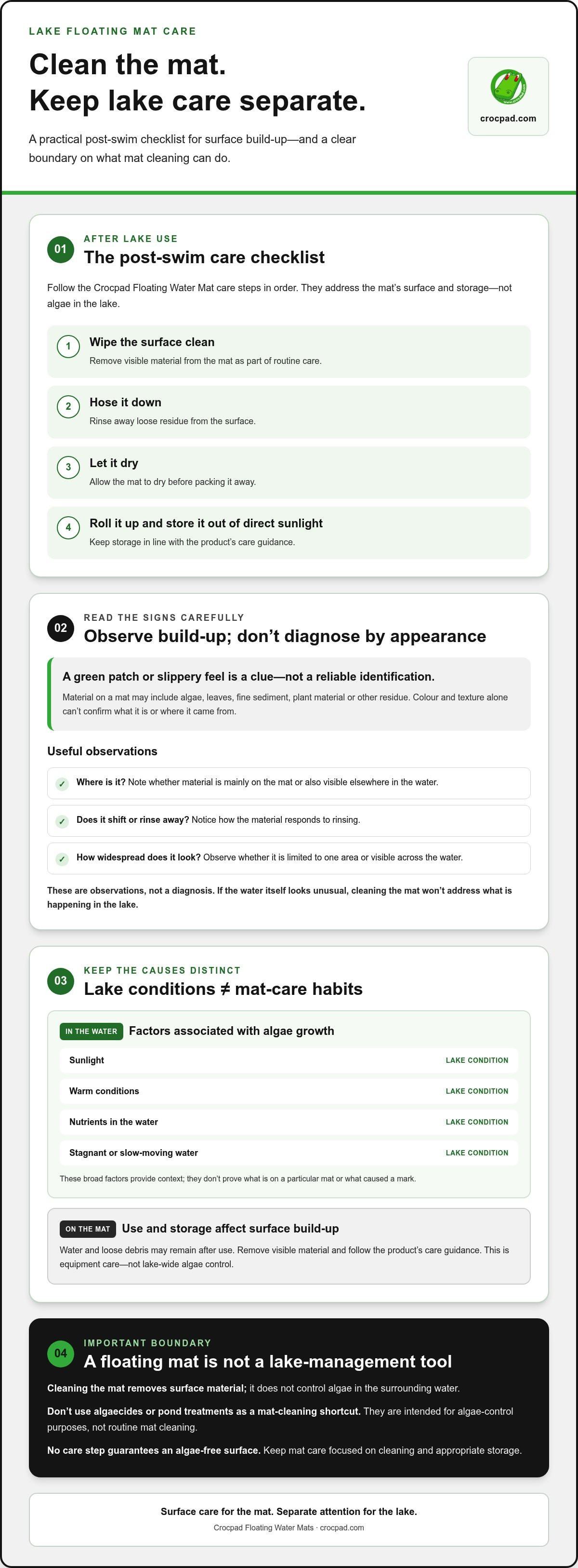
A simple post-swim routine helps keep mat maintenance manageable. Wipe the surface clean, hose it down, let it dry, then roll it up and store it away from direct sunlight. These are the care steps for Crocpad Floating Water Mats. Regular cleaning removes surface residue, but it doesn’t make a mat algae-proof or stop algae growing in the lake.
This guide explains how to distinguish visible build-up from a wider concern about the water, follow a practical rinse-and-store routine, and avoid treating the mat as a lake-management tool. The result is a straightforward way to care for your equipment after lake use.
Key Takeaways
- A green colour or slippery feel alone won’t identify what’s on a floating mat. Consider where the material appears and whether it rinses away, but don’t treat appearance as a diagnosis.
- Lake conditions and mat-care habits are separate considerations. Cleaning equipment won’t change what is growing in the lake.
- Preventing build-up on a lake floating mat means using practical care steps, not expecting the mat to control algae in the water.
- After lake use, wipe the mat clean, hose it down, let it dry, then roll it up and store it away from direct sunlight.
- Compare Crocpad Floating Water Mat sizes for your recreational plans, while keeping your choice of mat separate from lake algae management.
Algae on a lake floating mat: what is growing there?
Algae grow in water and other environments. Algae in a lake are part of the water body; material on a floating mat is surface build-up that may include algae, but could also be debris or other residue. The two can be connected, but they call for different responses: lake algae relates to the water, while marks on the mat call for appropriate product care.
A green patch or slippery feel is a clue, not a reliable identification. Colour and texture alone can’t tell you exactly what the material is or where it came from. For a general introduction to algae and its different forms, see What is Algae?
Is it lake algae, surface residue or something else?
Start by looking at where the material appears. Is it mainly on the mat, or can you also see growth or discolouration elsewhere in the water? Leaves, fine sediment and plant material can collect on a mat, while algae may be present in the lake or cling to a surface. These observations help you see where the build-up is, but they won’t confirm its exact cause.
Notice whether the material shifts or rinses away, and whether it is limited to one area or visible across the water. Treat these as observations, not a diagnosis. If the water itself looks unusual, cleaning the mat won’t address what is happening in the lake.
Why algae-control advice for lakes may not suit a floating mat
Lake-management advice concerns conditions across a water body, not routine cleaning of recreational equipment. Sunlight, warm water, available nutrients and limited water movement can support algae growth in some lake settings. Those factors provide context, but they don’t prove that a particular mark on your mat is algae or explain how it got there.
The purpose of each response is different. Lake management focuses on the water and its wider conditions; mat care focuses on removing material from the product and storing it appropriately. A method intended to manage algae in a lake isn’t automatically suitable for a mat, and advice about lake water isn’t automatically advice about cleaning equipment.
Keep the two tasks separate. Don’t apply algaecides or pond treatments to a floating mat as a cleaning shortcut. They’re intended for algae-control purposes, not routine mat cleaning, and appearance alone can’t establish what is on the surface. For practical guidance on how to prevent algae growth on lake floating mat surfaces, first decide whether you’re dealing with build-up on the product or a concern about the surrounding water. Then choose the appropriate approach for that specific problem.
What can encourage algae and residue around a lake floating mat?
Algae growth in a lake and build-up on a floating mat can be influenced by different conditions. Sunlight, warmth, nutrients and stagnant water are factors associated with algae in water bodies, but they don’t confirm that a particular mat has algae on it. A mat can also collect leaves, fine debris and other material during use. That is a surface-care issue, not lake-wide algae control.
Lake conditions influence algae in the water; use and storage habits influence what collects on equipment. Keeping these causes separate helps you choose a sensible response. A mark on a mat isn’t proof of a lake problem, and cleaning equipment won’t change conditions in the lake.
Lake conditions and algae in the water
Sunlight and warm conditions can support algae growth, while nutrients in the water can provide resources for it. Stagnant or slow-moving areas may also be favourable in some circumstances. These are broad environmental factors, not a diagnosis: a green patch on a mat doesn’t show which conditions are present or what caused the mark.
A floating mat is recreational equipment, not a lake-management tool. It doesn’t control algae across the surrounding water, and cleaning it won’t address algae growing elsewhere in the lake. Treat a concern about the water itself as separate from routine mat care.
Mat use, rinsing and storage habits
After a swim, water and loose debris may remain on the mat. If you put it away with material still on the surface, later cleaning may be less straightforward. This doesn’t mean algae is necessarily growing on the mat; it’s a practical reason to remove visible debris and follow the product’s care guidance after use.
For Crocpad Floating Water Mats, the care guidance is to wipe clean, hose down, roll up and store away from direct sunlight. Letting the mat dry before rolling it away is a practical part of pack-up. These steps support routine cleaning and storage, but they aren’t a guaranteed algae-prevention treatment. Avoid adding chemical treatments that aren’t part of the product’s stated care guidance.
Foam type, colour, thickness and mat size shouldn’t be treated as proof of algae protection. Choose a mat for your recreational needs, then keep its care routine focused on the surface. Explore Crocpad Floating Water Mats for lake recreation, and keep lake algae management separate from caring for your equipment.
Which floating-mat algae prevention methods are practical?
Think of these steps as parts of looking after equipment, not as treatments for algae in a lake. A wipe or rinse deals with the mat’s surface; drying and storage are about putting the mat away appropriately. None guarantees an algae-free surface, and none changes what is growing in the surrounding water.
| Method | Purpose | Limitation |
|---|---|---|
| Wipe-down | Address visible material on the surface. | Appearance alone can’t confirm what the material is. |
| Hosing | Rinse the surface as part of basic mat care. | Doesn’t manage algae in the lake. |
| Drying | Prepare the mat for being rolled away. | Doesn’t identify or treat remaining marks. |
| Storage | Put the mat away in line with its care instructions. | Isn’t an algae-control method for the water. |
Wiping and hosing after lake use
These are surface-care options, not algae-control measures. If you can see material on the mat, a wipe-down or rinse gives you a practical way to clean the equipment. The result may vary, and a clean-looking surface doesn’t prove what was there or indicate the condition of the lake.
Keep the method straightforward and within the mat’s care instructions. Don’t assume that adding a cleaning agent or algae treatment will make it more effective. The question of how to prevent algae growth on lake floating mat surfaces is best approached as routine product care, without treating the mat as a way to control algae in the water.
Drying and storage compared with leaving the mat out
Drying and storage serve a different purpose from wiping and rinsing. They’re the final part of putting equipment away, rather than a way to remove or identify a particular mark. Follow the product’s storage guidance. Leaving the mat out or storing it won’t prevent algae from developing in the lake.
Match each action to the task: clean visible material from the surface, then store the mat appropriately. If the concern is algae throughout the lake, mat-care steps aren’t a substitute for addressing the water body separately. Explore Crocpad Floating Water Mats for lake recreation, while keeping equipment care distinct from lake management.
How to prevent algae build-up on a lake floating mat: a simple routine
Make pack-up a quick check, not a diagnosis. A mark on the mat doesn’t identify its cause, so focus on what you can observe: where material has collected and whether it remains after cleaning. This gives you a practical way to decide whether another basic clean is needed, without reaching for an unverified treatment.
After every lake session: clean and inspect
Use this sequence to check the mat without guessing what a mark is:
- Look over the surface. Note where visible material has collected and remove loose debris gently. Avoid sharp tools that could damage the mat.
- Follow the product’s care guidance. Wipe the surface clean and hose it down. Don’t add unlisted products or treatments.
- Check the same areas again. If visible material remains, repeat the basic care steps and reassess the surface.
- Keep lake concerns separate. If the water itself looks unusual, cleaning the mat won’t resolve that wider concern.
This routine won’t guarantee complete removal or confirm that a mark was algae. It gives you a consistent way to notice build-up and respond without over-treating the mat.
Before storing: dry, roll and protect
Let the mat dry, then roll it up and store it away from direct sunlight, in line with the product’s storage guidance. Check it again before its next outing. If you notice new visible material, return to the basic care routine rather than assuming the lake or the mat needs an algae treatment.
Never tow the floating mat behind a boat or any watercraft. Towing voids the warranty and may cause injury. For lake recreation, explore Crocpad Floating Water Mats, and keep equipment handling safe and straightforward.
Choose a floating mat and care routine that fit lake use
Choose a mat with your lake setup in mind. Consider the space where you plan to use it, how you’ll get it to and from the water, and where you can store it between outings. Thinking through these practical details before choosing helps you find an option that fits your plans, rather than assuming one size suits everyone.
Match mat size to how you plan to use it
Start with the available space and the kind of recreation you have in mind. A mat for a compact launch area may call for a different size from one used where there’s more room. Also consider whether you can manage the mat at pack-up and store it as directed. These are useful selection considerations, not claims about capacity or performance.
Crocpad Floating Water Mats are made with marine-grade XPE foam. Treat that as a material detail, not evidence that the mat resists algae. Choose based on how you plan to use and store the mat, rather than expecting its construction to remove the need for care.
Keep care simple and expectations realistic
Before choosing, consider whether you can follow the product’s care and storage instructions after lake use. A routine that fits naturally into pack-up is easier to maintain than one that relies on extra products or unverified treatments. Keep the mat’s instructions close at hand and use them as your reference if visible build-up appears.
Choose for recreation, then care for the mat as directed. That keeps expectations grounded and your next lake outing easier to prepare for. To explore Crocpad’s floating-mat options, browse Crocpad Floating Water Mats and find a fit for your lake plans.
Make your next lake day easier to plan
A good mat-care habit starts before your next outing: choose a size that suits your recreational plans and make room in your pack-up routine to care for it. Crocpad Floating Water Mats come in 18 ft/5.5 m, 12 ft/3.65 m and 6.5 ft/2 m sizes. After use, wipe the mat clean, hose it down, let it dry, then roll it up and store it away from direct sunlight.
Keep expectations realistic. Knowing how to prevent algae growth on lake floating mat surfaces means caring for the mat itself, not assuming that its size or cleaning routine will control algae in the lake. A simple, repeatable approach helps you prepare for your next lake day without turning pack-up into a complicated chore.
Ready to choose a mat for your plans? Explore Crocpad Floating Water Mats and get set for more time enjoying the water.
Frequently Asked Questions
Can algae grow on a floating mat?
Algae can collect on a floating mat, but a green mark or slippery patch doesn’t confirm that it’s algae. Leaves, fine debris and other residue can also build up during lake use. Notice whether the material is limited to the mat or visible elsewhere in the water, but treat appearance as an observation, not a definite identification. Clean visible surface material using the mat’s care guidance.
How often should I clean a floating mat used on a lake?
Clean it after each lake session, particularly if you can see debris or residue on the surface. That gives you a regular opportunity to remove material before rolling the mat away. For Crocpad Floating Water Mats, the care routine is to wipe clean and hose down. If you use the mat again and notice build-up, clean it after that outing rather than waiting for a fixed calendar interval.
Should I use an algaecide to clean a lake floating mat?
No. An algaecide is intended for algae control, not as a routine cleaner for a recreational mat. Crocpad’s stated mat-care guidance is to wipe clean and hose down, so don’t add an unlisted chemical treatment to that routine. If you’re concerned about algae in the lake itself, keep that separate from cleaning your equipment; treating the mat won’t address algae throughout the water.
Does rinsing a floating mat stop algae growing in the lake?
No. Rinsing can wash material off the mat’s surface, but it doesn’t change conditions in the lake or prevent algae from growing elsewhere in the water. Think of it as equipment care, not lake management. If you’re working out how to prevent algae growth on lake floating mat surfaces, focus on suitable mat cleaning and keep any concern about the wider water body separate.
Can I leave my floating mat in the lake between uses?
Crocpad’s storage guidance is to roll the mat up and keep it away from direct sunlight while stored. Plan your between-use routine around taking the mat out, caring for it and storing it accordingly, rather than assuming the lake is its storage location. This also gives you a chance to check for visible debris or residue before the next outing.
How should I store a floating mat to reduce build-up?
Start with a clean mat and let it dry before rolling it up. Crocpad’s guidance is to wipe clean, hose down, roll up and store away from direct sunlight. Check that the surface is dry before putting the mat away. If you spot new residue before your next lake trip, clean the mat again using its care routine.
Can I tow a floating mat behind a boat to rinse it?
No. Never tow a Crocpad floating mat behind a boat or any other watercraft, including as a way to rinse it. Towing voids the warranty and may cause injury. Instead, remove the mat from the water and hose it down as part of its stated maintenance routine. Keep cleaning and transport separate, and don’t use a watercraft to pull the mat.


