

The best floating yoga mat platform for lake fitness depends on the movements you plan to do, not just the label on the product. A platform suited to gentle stretching or relaxing may not be the right fit for standing poses or more active exercise.
To compare options, look at the platform’s stated use, dimensions, surface details, portability and setup. These details can make a foam floating mat, inflatable fitness platform and purpose-built yoga board very different choices, even when product listings look similar. Crocpad’s Floating Water Mat is a durable, portable recreational option for pools, boats and open water, rather than a yoga-specific board. This guide helps you decide which type matches your routine and the way you want to spend time on the water.
Key Takeaways
- Match your platform to the movements you plan to do, rather than relying on a yoga or fitness label alone.
- Compare fitness boards, SUPs and floating mats by intended use, portability and setup needs.
- Consider whether the product’s design and the lake conditions suit your experience and planned workout.
- Use the checklist to compare dimensions, stated uses and practical features before choosing a floating yoga mat platform for lake fitness.
- Crocpad’s durable, portable Floating Water Mat is a recreational option for pools, boats and open water.
Floating yoga mat platforms for lake fitness: what are you choosing?
Taking your movement routine onto a lake can make familiar stretches feel fresh. But water-based platforms are not all designed for the same purpose. A floating fitness platform is a surface used on the water for movement or exercise, and its shape, construction and stated use can vary between products.
A yoga label alone does not tell you whether a platform suits your plans. Start by identifying the movements you want to do, then check whether the product information supports that use. A purpose-designed fitness board and a general-purpose floating mat may both offer a surface on the water, but they are not automatically interchangeable.
For a visual example, watch this review of an inflatable aquatic fitness platform:
How a floating platform differs from a regular lake float
Fitness equipment is selected with movement in mind. A specialised fitness board may be marketed for activities such as yoga or Pilates, while a regular lake float is generally intended for relaxing on the water. General-purpose floating mats sit in a broader recreational category. They can provide space to enjoy the water, but should not be assumed to have the design of a dedicated exercise board.
Look beyond labels and check the product details. Construction, surface, dimensions, support and setup can differ, so do not assume every platform has the same features. Match the maker’s stated use to your planned activity, and treat broad claims as a starting point rather than proof that a platform suits every exercise. For context, Water aerobics for lake fitness outlines how exercise in water differs from land-based activity.
Which lake workouts are you planning?
Start with the movements you want to do. Gentle stretching may need less room than standing poses, where balance becomes a more direct part of the practice. More dynamic movement can place different demands on you and the platform. Consider the exact poses or exercises you plan to try rather than assuming one product will suit all three.
Your session style matters, too. Solo practice has different space needs from casual recreation with others or an instructor-led session. Decide whether exercise will be the main activity or an occasional change from relaxing on the lake. If you are comparing a floating yoga mat platform for lake fitness, write down your planned activities and how often you expect to use it. This helps distinguish a specialist board from a recreational mat without treating either as the right choice for everyone.
Compare fitness boards, SUPs and floating mats for lake workouts
Platform labels can suggest intended use, but they do not guarantee that a particular product suits your routine. Compare the design and product-specific details side by side. A board promoted for fitness may be designed with exercise in mind, while an all-purpose floating mat may be better suited to recreation. Neither format is automatically right for every lake workout.
Use this table to identify what to investigate in each listing. The likely uses are general categories, not promises about every model.
| Format | Likely use | Portability considerations | Questions to investigate |
|---|---|---|---|
| Dedicated inflatable fitness board | Yoga or other water-based fitness, depending on the product’s stated use | Check how it packs down and what setup the listing describes | What are the dimensions? Is deck grip described? What setup is required? |
| SUP-style board | Paddling, with stationary exercise suitability varying by model | Compare its packed or carried form and preparation needs | Does the listing describe stationary exercise? How much usable deck space is provided? |
| General floating mat | Recreation and relaxing on the water; exercise suitability depends on design | Check how the mat is transported and prepared for use | What dimensions, activities and setup does the product information state? |
Dedicated inflatable fitness boards
Some inflatable boards are marketed specifically for yoga or water fitness. Compare the individual product listing’s surface details, dimensions and setup instructions with your routine, particularly if you plan to move between poses. A board’s fitness positioning does not guarantee that it will suit every movement, so check the details against the way you intend to use it.
SUP-style boards and general floating mats
SUP-style boards cover a broad category. A model intended for paddling should not automatically be treated as a stationary exercise platform; look for explicit information about its intended use. General floating mats offer another option for recreation on the water, but should not be mistaken for specialised yoga boards. Crocpad’s durable, portable Floating Water Mat is a recreational option for pools, boats and open water.
Think about the session you are planning, then compare the product details rather than relying on a category label. If you are weighing up the health context for exercising in or around water, the CDC’s overview of the health benefits of water-based exercise is a useful reference. For relaxed lake recreation alongside movement, explore the Crocpad Floating Water Mat as one versatile option, while keeping your workout’s specific needs in view.
Will a floating platform feel stable enough for lake fitness?
A floating platform can feel different from a studio floor. Water moves, and your balance may respond to small shifts beneath the platform. How steady it feels depends on the product’s design, lake conditions and the movement you are doing. A product described as “stable” does not promise that every person will feel secure doing every exercise on it.
That does not rule out a lake workout. It does mean setting realistic expectations: a seated stretch and a standing balance pose make different demands, and your experience on one platform will not necessarily predict how another feels.
What can affect balance on the water?
Water movement, wind and activity from other lake users can all affect conditions around you. Even when the surface looks calm, your platform may shift as you move. Standing poses and faster, dynamic exercises can make that movement more noticeable than seated or low-impact positions.
If you are new to exercising on a floating surface, start with simple movements in suitable conditions. Notice how the platform responds before progressing. Leave a more ambitious routine until you understand how the setup feels.
- Potential upside: Moving outdoors can make a familiar practice feel fresh and enjoyable.
- Practical trade-off: Water movement adds a balance challenge that you do not face on a firm studio floor.
- Worth remembering: A platform’s feel can vary with the conditions and your movements.
How to assess product claims responsibly
Read product claims in context. “Non-slip” describes a stated surface quality, while “stable” is a product claim. Neither phrase alone establishes how the platform will perform for your body, exercise or lake conditions. Anchoring language also does not guarantee that a setup is suitable in every location or situation.
Compare each listing’s stated activity, dimensions and surface details with your planned routine. If the product information describes lounging or general recreation, do not assume it is designed for standing yoga. Follow the maker’s instructions and use the platform only as directed.
- Check whether the product is described for your intended exercise, rather than relying on a broad fitness label.
- Consider whether its stated dimensions leave room for the movements you plan to practise.
- Look for specific surface information if grip matters to your routine.
- Read setup and anchoring instructions as part of the product’s use, not as a guarantee of safety.
Choosing a floating yoga mat platform for lake fitness means balancing the workout you want with the conditions you are comfortable managing. A fitness-specific design may be a closer match for regular yoga practice; a general recreational platform may suit more relaxed plans. Either way, use good judgement on the water.
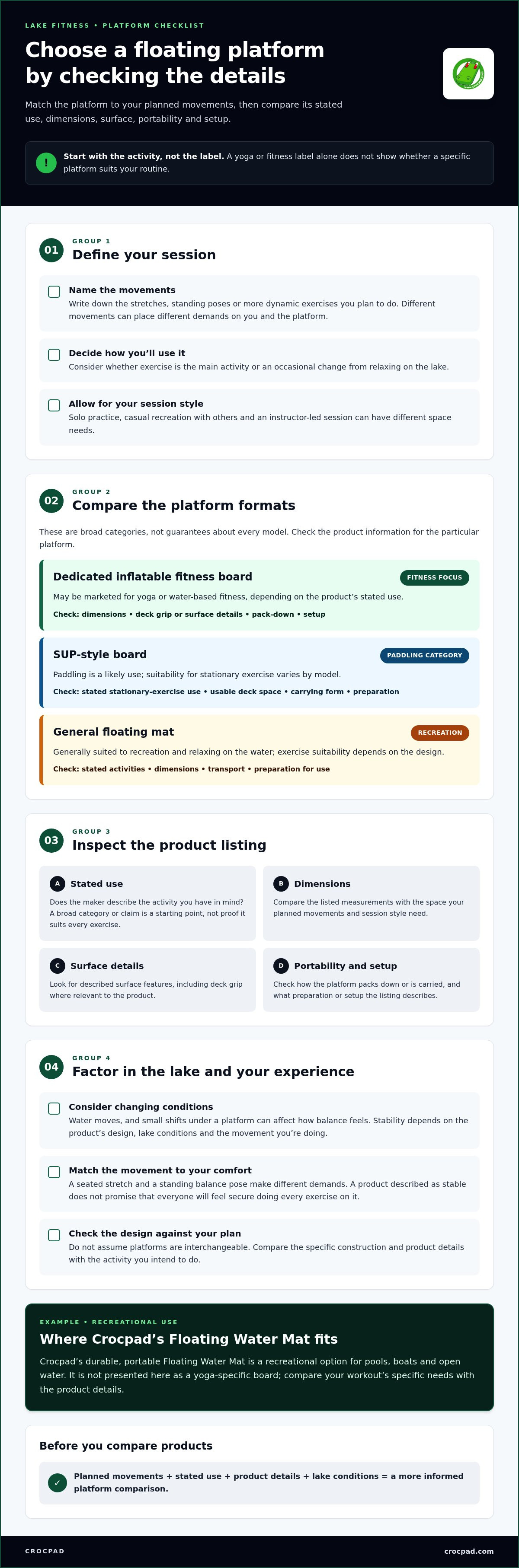
Use this checklist to choose a lake fitness platform
Turn your plans into a practical shortlist before comparing products. Start with the workout you will actually do, your experience on a floating surface and how often you expect to use the platform. Assess each product against the same criteria so an appealing extra feature does not distract from the basics your routine requires.
Match the platform to your routine
Be specific about your activity. Gentle stretching, standing poses and dynamic sequences can call for different amounts of space and different platform characteristics. Decide whether exercise is the main purpose, whether you will also relax on the water, or whether you want a mix. Choose for habits you can picture maintaining, not an ambitious routine you may try only once.
- Name your main activity. Write down the movements you plan to do, from seated stretches to standing or more dynamic practice. Use this list to judge whether a product’s stated purpose is a close match.
- Factor in your experience. Consider how comfortable you are balancing on a floating surface. If you are new to it, a simpler routine may be a more realistic starting point than advanced movement.
- Estimate how often you’ll use it. Regular fitness sessions may make a fitness-focused platform a better match, while occasional exercise alongside relaxing may point towards a more versatile recreational option.
- Compare dimensions and stated use. Review the product’s measurements and the activities its description names. Consider whether the available surface suits your movements instead of assuming all products in a category provide similar space.
- Check surface and setup details. Look for product-specific information about the deck surface and how the platform is prepared for use. Do not assume a feature is included unless the listing or instructions state it.
- Plan how you’ll transport it. Picture the route from storage to the water, including how you will carry or move the platform. Compare each product’s portability information with your transport arrangements.
- Allow for shared use. For a solo session, focus on your own movement area. For shared or instructor-led use, account for the space participants need, their experience levels and whether everyone can follow the setup and use instructions.
- Review guidance and conditions. Read the manufacturer’s instructions before setup and use. Consider current lake conditions and adjust your plans if they do not suit the activity or platform.
This process helps narrow the options without treating a “yoga” label as a guarantee of suitability. If a versatile recreational mat better fits your mix of relaxing and time on the water, compare the Crocpad Floating Water Mat with fitness-specific platforms.
Where Crocpad's Floating Water Mat fits into lake fitness plans
A lake session can include more than a workout. You might want to relax, enjoy the water and add casual movement to your day. Crocpad’s Floating Water Mat is a recreational mat for pools, boats and open-water environments, and can be considered alongside platforms designed specifically for fitness.
When a versatile recreational mat may suit your plans
If your plans mix downtime with light, casual movement, a recreational mat may fit the way you want to spend time on the water. Be clear about what “movement” means for you: a relaxed stretch during a break is different from a regular sequence of standing poses or dynamic exercise. Let your intended activity guide your decision instead of assuming a recreational product is designed for dedicated yoga.
Use product-specific information to judge the match. Compare the activities the mat is described for with the one you have in mind, and do not assume unstated features. If your routine centres on yoga or more demanding fitness movements, a specialised board may be a more suitable category to explore. If leisure is the priority and movement is an occasional extra, a versatile recreational mat may align more closely with your plans.
Be realistic about how you will use it, too. A product that suits your usual day on the water may be more practical than one selected for activities you are unlikely to do. Crocpad’s Floating Water Mat is a recreational option, not a purpose-built yoga board, so keep that distinction in mind when choosing.
Take the next step with Crocpad
Before settling on a platform, bring your decision back to four things: the activity you intend to do, the format that suits it, the details provided for that specific product and the setup it requires. Then decide whether you want a fitness-focused platform or a mat for broader recreational use. This keeps expectations clear and helps you choose gear that fits your time on the water.
If a recreational mat suits your plans, explore Crocpad’s Floating Water Mat and consider how it could fit into your time on pools, boats or open water. For a workout built around specific poses or dynamic movement, compare your routine with the product’s stated use before choosing. A clear plan helps you make the most of a change of scenery.
Make your next lake session your own
Your ideal setup starts with an honest picture of how you want to spend your time on the water. If your plans centre on regular yoga or active exercise, choose a platform whose stated use and details align with those movements. If you want a more relaxed, mixed-use day, a recreational mat may be a better fit. Let the activity lead, not the label.
Before you decide, picture the whole session: getting your gear to the water, setting it up and moving in conditions that feel comfortable for you. This practical check can help turn a tempting purchase into a choice you will be glad to use. The right floating yoga mat platform for lake fitness is the one that fits your real plans, not every possible workout.
Ready to add more time on the water to your leisure plans? Explore Crocpad’s Floating Water Mat and see how it could fit your next outing. Choose thoughtfully, take it at your own pace and enjoy the fresh-air reset.
Frequently Asked Questions
Can you do yoga on a floating mat in a lake?
Yes, if the particular mat is intended for the activity and the conditions and your experience suit it. A recreational mat is not automatically designed for yoga, while a platform described for fitness may provide more relevant guidance. For a floating yoga mat platform for lake fitness, read the product instructions before use. Begin with brief, gentle movement, pay attention to how the surface responds and stop if you feel unsure.
What is the difference between a floating yoga board and a floating water mat?
A yoga or fitness board is marketed for movement, while a general floating water mat may be made for broader recreation. The name alone does not tell you how much grip a surface offers, how it will feel underfoot or which activities it is intended for. For example, do not assume a mat described for relaxing is suitable for a standing flow. Compare each product’s description and specifications with your planned workout.
Are inflatable fitness boards suitable for beginners?
They can suit some beginners, but suitability varies by board, person and activity. A fitness label alone does not tell you how manageable a board will feel. Read the instructions, choose conditions that feel comfortable and start with simple, low-intensity movement rather than a challenging sequence. Water movement can make balance feel different from exercising on land, so take time to adjust. Do not treat a product description as a guarantee of safety or ease.
Can you use a floating fitness platform when the lake is windy?
Wind and changing water conditions can affect comfort and control, with the impact depending on the platform and setting. Assess conditions before heading out, including whether gusts or surface movement make your planned activity uncomfortable. Follow the platform’s directions and stop if conditions become unsuitable. There is no universal wind threshold for every setup, and an anchoring arrangement is not proof that a platform is safe to use in all conditions.
How do you keep a floating exercise platform in place?
How a platform is positioned depends on its design and the conditions, and anchoring options differ between products. Check the manufacturer’s instructions for any approved positioning or anchoring method, then use only the arrangements they specify. Do not improvise attachments or assume that a platform supports anchoring because another model does. Even a recommended setup cannot promise the platform will remain stationary, so consider movement on the water before beginning your activity.
Can several people exercise together on one floating platform?
That depends on the product’s stated capacity, dimensions and intended use. Do not estimate group suitability from how spacious a platform looks in a photo; compare the manufacturer’s specifications with the number of people and the activity planned. A shared stretching session differs from several people moving at once, which can change how the platform feels. If the product information does not describe group exercise, do not assume that use is suitable.


