

A higher PSI doesn’t automatically make a sandbar setup the right one. Choosing a high psi inflatable floating dock for sandbar use can seem like a straightforward way to get a firmer platform, but pressure alone won’t tell you whether it suits your plans. The product’s construction, its stated use and the conditions on the day all matter.
Before comparing pressure ratings, decide what you need the float to do. A platform-style dock and a recreational mat suit different kinds of water time, and each comes with its own setup and handling considerations. This guide explains what a pressure rating can tell you, what to consider at a sandbar and how to compare options without relying on a one-size-fits-all PSI target.
Start with your group, gear and access needs. Crocpad’s Floating Water Mat is a recreational option for use around pools, boats and open water. Compare its intended use with your plans, then review the product’s information and instructions before deciding.
Key Takeaways
- Match the float to your plans: a platform-style dock and a mat suit different ways of relaxing, swimming or gathering on the water.
- Follow the product’s stated PSI guidance, but don’t use pressure alone to judge durability, capacity or suitability for a sandbar.
- Before choosing a high psi inflatable floating dock for sandbar use, consider the space you need, transport and how you’ll manage the setup.
- Plan for wind, current, changing water levels and the distance between your boat, the float and shore.
- Decide what kind of floating space you want, then compare product type and stated specifications. Crocpad’s Floating Water Mat is designed for recreational use with boats and in open-water environments.
High-PSI inflatable floating docks for sandbars: what are you choosing?
A floating base can give you a place to swim, stretch out or gather between dips during a sandbar stop. But an inflatable dock and a floating mat aren’t interchangeable just because both sit on the water. Before focusing on pressure, decide how you want to use the float and how much shared space you need.
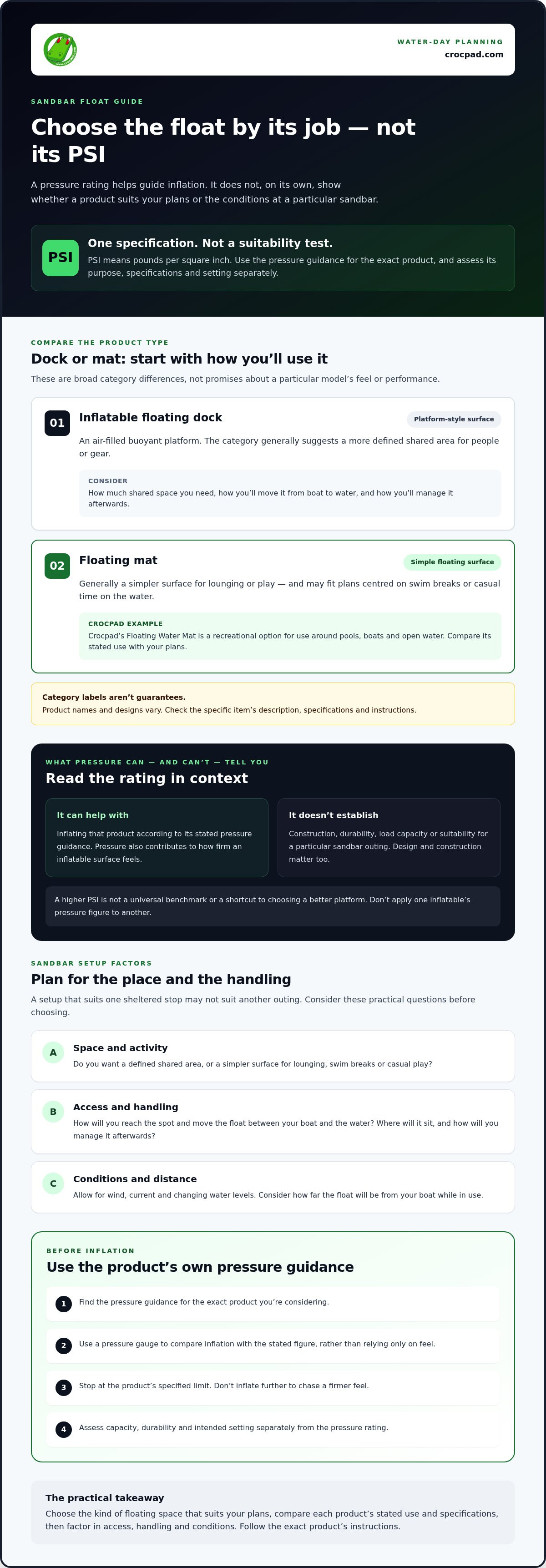
An inflatable floating dock is an air-filled buoyant platform. The term usually suggests a more platform-like surface for people or gear, while a floating mat is generally a simpler surface for lounging or play. These are broad product-category distinctions, not promises about any model’s firmness, capacity or performance. Check the specific product’s description and instructions.
A pressure rating describes the air pressure inside an inflatable product. It doesn’t, by itself, tell you whether that product suits your plans or the conditions at a particular sandbar.
PSI means pounds per square inch, a unit used to express pressure. A higher figure may sound like a shortcut to a firmer-feeling platform, but it doesn’t establish construction, durability, capacity or suitability for an outing. For background on air-filled craft and their construction, explore inflatable boat technology. Apply a pressure rating only to the product it belongs to, and follow that product’s stated inflation limits.
How is an inflatable dock different from a floating mat?
Start with the activity, not the label. A platform-style dock may suit a group looking for a defined shared area. A mat may better fit a plan centred on lounging, swim breaks or casual play. These are general comparisons, not guarantees of how a specific item will feel or perform.
Next, think through the setup. How will you move the float from your boat to the water? Where will it sit during use, and how will you manage it afterwards? Product names vary, so compare each item’s stated use and instructions rather than assuming every “dock” or “mat” has the same design.
What makes a sandbar outing different?
A sandbar stop adds practical planning questions. How will you reach the spot and move the float between your boat and the water? How far will the float be from the boat while in use? Consider wind, current and changing water levels instead of assuming every sandbar offers the same conditions.
A setup that suits a sheltered stop may not suit another outing. The high psi inflatable floating dock for sandbar decision is about more than a number: compare the product’s intended use with your access, handling needs and expected conditions.
What a high-PSI rating tells you about an inflatable floating dock
A PSI figure is useful when inflating a product, but it’s only one part of understanding how that product is designed to perform. For an inflatable dock, the number gives the inflation limit or target set for that product, not a universal benchmark for choosing gear.
A PSI rating is one specification, not a complete suitability test. It helps you inflate a product according to its instructions, but doesn’t establish its durability, load capacity or suitability for a particular sandbar outing. Consider the product’s stated purpose and other specifications alongside the conditions and handling involved in your plans.
Why does pressure affect an inflatable platform?
Inflation pressure contributes to how firm an inflatable surface feels, but it isn’t the only factor. Construction and overall design also affect how a product behaves. Two inflatables with similar pressure guidance shouldn’t automatically be treated as equivalent. Compare each product’s intended use and instructions rather than assuming a higher PSI means a better platform for every outing.
How should you read the manufacturer’s pressure guidance?
Use the inflation instructions supplied for the exact product you’re considering. A pressure gauge can help you compare inflation with the stated guidance instead of relying only on feel. Don’t exceed the stated limits or apply a pressure figure from another inflatable. Follow any specified method or sequence as well.
Use this quick check before inflation:
- Find the pressure guidance for the exact product, not just its general category.
- Use a gauge to compare inflation with the stated figure.
- Stop at the product’s specified limit. Don’t inflate further to chase a firmer feel.
- Assess capacity, durability and intended setting separately from the pressure rating.
That distinction matters when choosing a high psi inflatable floating dock for sandbar use. A pressure rating won’t tell you whether the platform suits the way you plan to relax, swim or gather. Read the product information as a whole, then consider the setting separately. Wind, current, changing water levels and the distance between the float and your boat can all affect the practical demands of the day.
For recreational time on the water, Crocpad’s Floating Water Mat is designed for use with boats and in open-water environments. Consider it as a floating mat, not as a high-pressure dock with an assumed PSI rating. Start with the type of floating space you want, then compare each product’s stated specifications.
Inflatable dock or floating mat: compare the setup for your sandbar day
Choose according to the outing, not which label sounds more substantial. A shared base for a group calls for different space and handling considerations than a simple surface for lounging between swims. Use this comparison to narrow down the product type, then check the specific product’s intended use and instructions.
| Consideration | Platform-style dock | Floating mat |
|---|---|---|
| Typical use | A defined shared area for relaxing or gathering. | A recreational surface for lounging, play or swim breaks. |
| Space | Consider how much room your group wants to share and where the platform will sit. | Think about who’ll use the mat and whether its available surface suits the activity. |
| Transport and setup | Plan for carrying, inflation and managing the platform at your chosen spot. | Consider how you’ll transport, prepare and handle the mat during the outing. |
| Best fit depends on | Group plans, space needs and willingness to manage the setup. | A more casual floating plan and the product’s stated use. |
When might a platform-style dock suit the plan?
A platform-style dock may appeal if your group wants a shared floating area rather than separate places to lounge. Before choosing one, picture the outing: who’ll use it, how much shared space you want and how long you’ll be on the water. Then account for transporting and inflating it, as well as following its instructions for handling or securing it. A larger-looking platform isn’t automatically the better fit if access or setup is awkward.
When could a floating mat be the simpler option?
A mat may suit a recreational plan centred on lounging, play or dipping in and out of the water, without needing a dock-style base. Consider your group and preferred activities, then compare them with the mat’s stated use. Crocpad’s Floating Water Mat is designed for recreational use with boats and in open-water environments. It’s a mat, not a high-PSI dock, so don’t assume dock-like specifications or capacity.
Duration matters, too. For a brief stop with changing activities, consider how easily you need to move between the boat, water and float. For a longer gathering, give more weight to the shared space you want and how you’ll manage the setup throughout the day. Conditions and access can affect what’s practical, so don’t assume every dock or mat suits every sandbar.
Use the phrase high psi inflatable floating dock for sandbar as a starting point for comparison, not the final decision. First define the purpose: a shared platform or a recreational floating surface. Then assess space, transport, inflation and handling against your plans. This keeps the choice grounded in the day you want, rather than product terminology alone.
For recreational floating, Crocpad’s Floating Water Mat is an option designed for use with boats and in open-water environments.
Plan a sandbar floating setup with conditions, access and handling in mind
A good setup starts before the float reaches the water. Conditions, the route between your boat and the chosen spot, and the way your group will use the float all affect what’s practical. Work through those factors first, choose gear that suits the plan and follow its instructions. A pressure figure alone can’t settle the decision.
Checklist: assess conditions and access, match the product to your group, follow its instructions, then consider pressure within its stated limits.
- Check conditions. Review current forecasts before setting off, then pay attention to the water conditions you observe during the outing. Wind, current and changing water levels can affect how manageable a floating setup feels at your chosen spot. No single tide, current or weather threshold applies to every location and outing.
- Plan access. Work out how people and gear will move between the boat and the float. Consider the distance, who’ll carry or manage the setup, and whether that route is practical for everyone in your group.
- Choose for the group. Consider how many people plan to use the float, what they want to do and how long they expect to stay. A relaxed swim stop may call for different space and handling needs than a longer gathering.
- Prepare the product. Inspect it and follow its supplied inflation and use instructions. Plan how you’ll transport, launch, manage in the water and pack it away.
What should you assess before heading out?
Check the forecast and the conditions you encounter, and don’t assume they’ll stay unchanged. Consider how wind, current or a shift in water level could affect the distance between your boat, the float and shore. Keep the setup within a manageable distance for your group, and think through how each person will travel between the boat and floating platform. Base your decision on the actual outing, not a universal threshold.
How can you prepare the inflatable gear?
Before use, inspect the product and read its instructions from start to finish. Follow the stated inflation guidance and use only the handling or securing method described for that product. Think through the full sequence, from carrying it to the water to packing it away. A setup that’s manageable at each stage can make the day easier for the group.
For a high psi inflatable floating dock for sandbar outing, keep the order clear: assess conditions first, read the product instructions, then inflate within the stated guidance. If a recreational mat better suits your plans, explore Crocpad’s Floating Water Mat, designed for use with boats and in open-water environments.
Choose your Crocpad floating gear for a day on the water
Make the choice in this order: start with the outing, decide whether a mat or platform-style float suits it, then compare the product’s information and instructions. Your group’s preferred activities, the conditions at your chosen spot and the effort involved in carrying and setting up the gear all matter. A pressure figure can inform how an inflatable product is set up, but it shouldn’t lead the decision on its own.
What does Crocpad's Floating Water Mat offer for recreational use?
Crocpad’s Floating Water Mat is a recreational floating option designed for use with boats and in open-water environments. It’s relevant to consider for a day out on the water, but it shouldn’t be treated as a high-PSI dock. Don’t infer a pressure rating, capacity or performance for a particular sandbar. Use the product information and instructions to understand the mat’s intended use.
For a practical comparison, picture your day from launch to pack-up. If your plan centres on relaxing or taking swim breaks, consider whether a floating mat matches those activities. If you want a defined shared platform, compare platform-style products by their stated purpose and setup requirements. For either option, factor in your group’s needs and how you’ll move the gear between boat and water.
What are the next steps before choosing?
Before settling on a setup, run through the details that connect the gear to your actual outing:
- Outing: Decide whether the float is for lounging, swim breaks or gathering, and who’ll use it.
- Location: Consider the conditions you expect, including wind, current and changing water levels.
- Transport: Plan how you’ll carry, launch, manage and pack away the float.
- Product guidance: Read the intended use, specifications and instructions for the exact product.
Consider these factors together. A product that sounds right by name may not suit the access, space or handling needs of your day. A mat and a platform-style dock also don’t share specifications simply because both float. Compare like with like, and make sure the product information addresses the needs of your planned use.
If a recreational mat fits your plans, take a look at Crocpad’s Floating Water Mat and floating gear and review its product information before deciding. When comparing a high psi inflatable floating dock for sandbar outings, match the product type and its stated guidance to the day you’re planning, not to pressure alone.
Make your next day on the water your own
Before your next outing, picture what you want your floating gear to support: a quiet place to lounge, a base for swim breaks or room to gather with your group. That can help you decide what type of float to bring and which details to prioritise. If a high psi inflatable floating dock for sandbar use is on your shortlist, let your plans and the product’s instructions guide the decision rather than choosing by pressure alone.
For a recreational alternative, Crocpad’s Floating Water Mat is designed for use with boats and in open-water environments. Compare its product information with your outing plans, then choose the floating setup that fits the way you want to spend the day.
Explore Crocpad’s Floating Water Mat and plan for a relaxed day on the water.
Frequently Asked Questions
What PSI should an inflatable floating dock be for a sandbar?
There isn’t one PSI figure that suits every inflatable dock or sandbar outing. Use the inflation guidance supplied for the exact product, and don’t substitute a rating from another model. A dock’s recommended pressure won’t tell you whether its footprint, intended use or handling needs suit your plans. Compare those details separately, then inflate according to the product’s instructions.
Is a higher-PSI inflatable dock better?
Not necessarily. A higher pressure rating alone doesn’t establish that a dock is a better match for your group or outing. Compare each product’s stated purpose, specifications and setup with your plans, rather than choosing the number that looks most impressive. For instance, consider whether the effort of transporting a platform is worthwhile for the length and style of your stop.
Can you use a floating mat at a sandbar?
A floating mat may suit a sandbar outing if its stated use and instructions align with the conditions and your plans. Crocpad designs its Floating Water Mat for use with boats and in open-water environments, but that doesn’t mean it suits every sandbar or set of conditions. Consider the route from boat to float, where it will be used and how your group will manage it.
What is the difference between an inflatable dock and a floating mat?
An inflatable dock is generally a platform-style floating surface, while a mat is typically a simpler surface for recreational use. The distinction can help you decide what kind of space you want, but product labels alone don’t establish performance. If you want a defined shared area, look closely at the dock’s intended use and instructions. If you want casual lounging, assess a mat on its own terms.
How do you inflate a high-PSI floating dock safely?
Follow the instructions supplied with the specific dock, including its stated inflation limit and any recommended inflation method. Use a suitable pressure gauge to compare inflation with that guidance rather than judging only by feel. Don’t exceed the product’s limit or apply a pressure figure from a different product. If the instructions call for checks during setup, complete them before taking the dock onto the water.
What should you check before taking an inflatable dock to a sandbar?
Check the forecast and the conditions you observe, then think through access and handling. Consider whether everyone in your group can manage the trip between the boat and the float, and whether changing water levels, wind or current could affect your plan. Review the dock’s intended use and instructions before setting out. If conditions or access don’t suit the setup, reconsider the plan.
Does Crocpad sell a high-PSI inflatable floating dock?
Crocpad offers the Floating Water Mat, a recreational mat designed for use with boats and in open-water environments. It’s a mat, not a high-PSI dock, so don’t apply dock pressure ratings or assumptions about capacity to it. Compare the mat’s product information with your intended use and conditions, then follow its supplied instructions.


