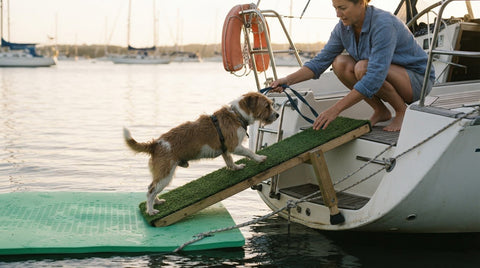
The easiest way to launch a kayak on a lake may be from the water, not the shore. A lake floating platform for launching kayaks and SUPs can provide a stable, water-level place to get on and off, avoiding some of the awkwardness of rocky beaches or high docks. Inflatable and modular platforms are options, but inflatable docks are best suited to calm, protected water.
If rocky shorelines, awkward lifts or slippery launches are putting you off paddling, a simpler way onto the water may help. Choose a setup that suits your craft, available space and lake conditions, and make sure it can be securely anchored away from boat routes.
This guide explains how to compare launch options, choose a platform for your needs, and set it up and use it safely. It also covers practical trade-offs between platform types and costs, helping you focus on a launch that fits your lake and paddling routine.
Key Takeaways
- Choose a platform to suit your kayak or SUP, the people using it and the conditions at your launch site.
- Secure the platform before use, with anchoring that accounts for wind, water movement and changing levels.
- Position your launch away from boat routes, fast current, rough water and sharp shorelines.
- Make launching and landing steadier by keeping the platform clear and approaching it with control.
- Match the platform type to your lake and intended use, then explore Crocpad’s Floating Water Mat as a recreational option.
Anchoring and securing a floating platform
Permit requirements vary by lake. The relevant council, state authority or land manager decides whether a floating platform or shoreline work needs approval. Find out who manages the site before planning an installation.
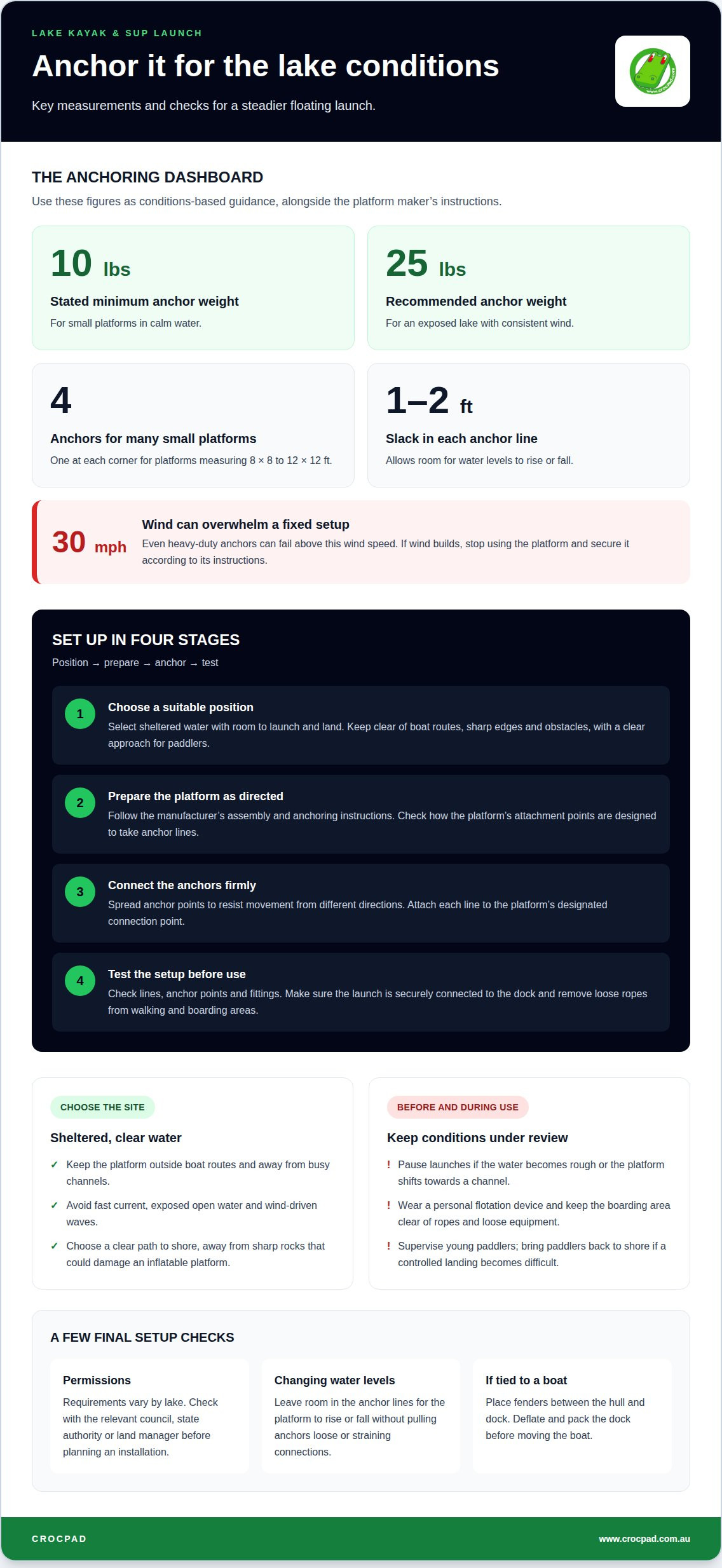
Set up a kayak and SUP launch in stages: choose the position, prepare the platform, connect its anchors, then test the setup before use. This sequence helps keep a floating dock steady as people board and water levels change.
- Choose a suitable position. Select sheltered water with enough room to launch and land. Keep the platform clear of boat routes, sharp edges and obstacles. A floating dock should sit where people can approach without crossing other water users’ paths.
- Prepare the platform as directed. Follow its manufacturer’s assembly and anchoring instructions. If buying floating docks, check how their attachment points are designed to take anchor lines. Inflatable docks often suit a sheltered lake, where two anchor points usually hold them.
- Set anchor weight for the conditions. For small platforms in calm water, the stated minimum is 10 lbs. On an exposed lake with consistent wind, the recommendation is 25 lbs. Treat these as conditions-based guidance, not a substitute for the platform’s own instructions.
- Secure each corner where required. Most small floating platforms measuring 8x8 to 12x12 ft require 4 anchors, one at each corner. Spread the anchor points to resist movement from different directions, then connect each line firmly to the platform’s designated attachment.
- Allow for changing water levels. Leave 1-2 feet of slack in each anchor line. That gives the platform room to rise or fall without pulling the anchors loose or placing unnecessary strain on the connections.
- Check every connection before use. Make sure the launch is securely connected to the dock. Inspect lines, anchor points and fittings, then remove loose ropes from walking areas. A line across the boarding route can create a trip hazard.
- Reassess when conditions change. Even heavy-duty anchors can fail in wind speeds above 30 mph. Don’t rely on a fixed setup if wind builds; stop using the platform and secure it according to its instructions. If it’s tied to a boat, place fenders between hull and dock, then deflate and pack the dock before moving the boat.
Avoiding boat channels, current, waves, and sharp shorelines
Choose calm, protected water for a floating launch, away from busy channels and exposed shorelines. The site should give paddlers room to board while keeping the platform clear of boat traffic, fast currents and sharp rocks.
- Position the launch outside boat routes. Leave the channel open and avoid placing a platform where it narrows a boat route. Don’t position it where a boater rounding a point could meet it unexpectedly. Check the approach from both the launch and the water, not just from the shore.
- Choose calm, protected water. Inflatable docks are best suited to sheltered water. Avoid fast current and exposed open water, where moving water and wind-driven waves can shift the platform or make boarding difficult. If conditions are rough, postpone kayaking rather than trying to launch through chop.
- Keep clear of sharp shorelines. Rocks and other sharp edges can damage an inflatable platform. Choose a launch point with a clear path between shore and water, and remove nearby obstacles that could snag equipment or ropes. A rocky beach may also make carrying a kayak or SUP awkward.
- Prioritise clear, accessible boarding. A water-level platform can make getting onto a kayak or paddleboard easier than launching from a rocky beach or high wooden dock. Choose an unobstructed boarding area, keep ropes and equipment out of the way, and leave space for paddlers to steady their craft.
- Keep safety gear ready. Wear a personal flotation device and check your gear before launching. Keep the boarding area free of loose equipment and ropes, which can create trip hazards. Supervise young paddlers using the launch, and avoid setting off if waves or current make control difficult.
- Watch for changes before and during use. Wind can build across an exposed lake, while passing boats can send waves towards the platform. Pause launches if the water becomes rough or the platform shifts towards a channel. Bring paddlers back to shore if conditions make a controlled landing difficult.
- Plan a simple return route. Pick a landing point with room to approach without crossing boat traffic or brushing against rocks. Tell paddlers where to return, and keep the route clear of other craft. For example, a sheltered cove may provide a calmer approach than an exposed point.
For a more relaxed day on the water, browse water recreation gear suited to lakeside fun.
Kayak launch products and price ranges
Compare the complete purchase and setup, not just the listed price. A lake floating platform for launching kayaks and SUPs needs to suit the site, craft and people who will use it.
-
Choose a suitable platform type
Choose an inflatable or modular platform based on how you’ll transport, store and use it. Compare the full setup rather than assuming products with similar names work alike. For inflatable options, follow the maker’s instructions for inflation, handling and use. For modular docks, check how the sections connect and whether the layout suits your shoreline.
-
Set dimensions and load capacity
Measure the launch area and plan how people will board, prepare their craft and move around the platform. Check the listed capacity against the people and equipment expected on deck. A kayak can take up space needed for boarding, so don’t choose a platform by its overall dimensions alone.
-
Check what the listed price covers.
Read the product description to see what comes with the platform and what must be purchased separately. Compare equivalent setups, including any connecting components or anchoring equipment required. A lower listed price may cover a different configuration, so check the contents before comparing totals. Keep the platform cost separate from site work.
-
Factor in site-specific setup.
The cost of setting up a launch depends on the site and work involved. A ready-to-use platform and a fixed dock can have different installation needs. Consider water access, shoreline layout and how the platform will be secured. A difficult approach, for example, may require extra handling that isn’t reflected in the product price.
-
Compare ongoing care and practical value.
Review care instructions, storage needs and warranty terms before buying. Consider whether you can store the platform appropriately and follow its maintenance guidance after lake use. These details affect how well it fits your routine. Choose a lake floating platform for launching kayaks and SUPs based on practical needs, not simply the lowest advertised price.
Treat that range as a planning reference, not a quote for a particular shoreline. Site conditions, access and the work involved can all affect the setup. Compare installation needs alongside the platform price, and confirm what a proposed installation includes and whether the launch site needs preparation before judging affordability.
That range can help set an initial product budget, but it isn’t the cost of a complete launch setup. Check that the selected platform suits the intended users and craft, and find out whether connecting or anchoring components are included. Then compare the product cost with installation work and ongoing care. Keeping these costs separate helps you assess whether an inflatable platform or dock arrangement fits the site and your routine. A lower initial price may not be the better fit if the option doesn’t meet practical needs or requires an unexpected setup. Review the full configuration before buying.
Using floating platforms to launch kayaks and paddleboards
Launch in a controlled sequence: prepare the craft, clear the boarding area and move onto the water carefully. A platform can also provide a place to land and keep gear between paddles.
- Prepare the platform and launch area. Allow 15-30 minutes for two people to set up an inflatable water platform. Follow its inflation instructions, and use the stated 0.3-0.5 PSI range only when it applies to that platform. Keep paddles, ropes and loose equipment out of the boarding path before bringing a kayak or paddleboard aboard.
- Choose materials by the platform’s design and use. There isn’t one best choice among HDPE, aluminium and timber for every lake launch. Match the material to the complete platform’s intended use, load rating, maintenance needs and manufacturer instructions. Compare the finished setup, not material names alone: a stable launch depends on how its parts work together.
- Position the kayak before boarding. Set the kayak so its back third overhangs the rear of the deck. This leaves the craft positioned to move off the platform without crowding the boarding area. Keep the kayak aligned with the intended route, and avoid placing paddles or bags where they could catch under the hull.
- Board with a controlled transfer. Keep your weight low as you move from the platform into the kayak. Hold the craft steady, settle into the seat, then check that the paddle is within reach before pushing away. For a paddleboard, place it alongside the platform and transfer your weight gradually rather than stepping sharply onto one edge.
- Approach the platform with momentum. From the water, approach the floating launch carefully and keep the kayak under control as you move onto it. Use a controlled approach to bring the kayak onto the platform. Keep your approach straight and controlled; a sharp angle can make the bow slide sideways instead.
- Keep jumping separate from launching. Place the platform in water at least 3 feet deep to reduce the risk of bottom impact when jumping. Diving requires at least 9 feet of water. These depth recommendations concern jumping and diving, not a requirement for ordinary kayak or SUP launching.
- Secure craft between trips. Optional storage straps can hold a kayak on the launch while it’s not in use. Keep straps clear of the boarding route, and remove them before pushing off. For example, store the kayak parallel to the platform so paddlers can still access the launch edge.
What types of floating platforms are suitable for launching kayaks and SUPs on a lake?
Match the platform type to your lake, craft and launch routine. Inflatable and modular floating platforms differ in transport, layout and setup.
- Choose an inflatable platform for portability. Inflatable platforms weigh 70% less than equivalent-sized plastic modular docks. That lower weight can make transport and storage easier when you pack equipment away between outings. They’re best suited to calm, protected water, rather than fast current, exposed open water or busy channels.
- Consider modular sections for a configurable layout. Modular plastic docks can be arranged to suit the shoreline and the way people approach the water. Compare the assembled footprint with the space available for kayaks and SUPs. Check how the sections connect and whether the finished platform leaves a clear area for boarding and landing.
- Separate floating launches from fixed docks. A fixed dock can provide a familiar access point, but it isn’t a floating platform. The difference matters when the launch needs to sit at water level or move with changing conditions. Compare the actual boarding height and route into the water, not simply the product label.
- Match the platform to the lake conditions. An inflatable launch suits a sheltered cove better than an exposed point with regular wind and waves. Avoid fast current, sharp rocks and busy boat routes, whatever platform type you choose. For example, a sheltered shoreline with a clear paddling route gives an inflatable platform a more appropriate setting.
- Plan around transport and storage. Consider how the platform will reach the water and where it will be stored after use. An inflatable option can be deflated for packing, while modular sections need room for their components. Choose the setup that fits your usual routine, rather than a layout that’s difficult to move or store.
- Compare the complete setup, not just the deck. Look at the platform, its connections and the anchoring arrangement as one system. A launch that’s easy to carry still needs to be securely positioned for use. Check that its layout leaves enough room for people to handle a kayak or paddleboard without crowding the edge.
- Choose for launching, not appearance alone. A wide recreational mat may offer space for relaxing, while a launch platform needs a practical route for boarding and moving craft. Decide whether paddling access is the main purpose, then assess the usable surface and approach. Explore floating water recreation options as you consider recreational platforms.
Crocpad: Floating Water Mat
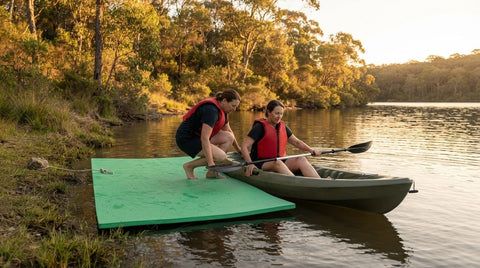
Crocpad’s Floating Water Mat provides a recreational space for relaxing by the lake. It may suit paddlers who want to enjoy time on the water beyond launching and landing.
Choose a purpose-built platform with an appropriate rating for boarding a kayak or SUP. Treat the Floating Water Mat as a leisure product, not a launch dock with assumed load capacity, anchoring points or craft-support features. Matching equipment to each activity avoids relying on specifications that aren’t listed.
If you’re planning a lake day and want to explore the Floating Water Mat, contact Crocpad to discuss your requirements.
Make your next lake day count
Before your next outing, plan the full launch routine: where you’ll prepare your craft, how you’ll board and what will make returning to shore straightforward. This helps you choose a lake floating platform for launching kayaks and SUPs that fits your paddling habits, rather than buying on appearance alone. Keep the intended use clear when comparing a dedicated launch platform with recreational water products.
Crocpad’s water recreation range also includes the Minima Pool Slide and Megalo 3M Inflatable Water Pool Slide. For help exploring Crocpad’s offerings alongside your plans for time on the water, contact Crocpad about your launch. Take the next step towards a lake day that suits you, and enjoy getting out on the water.
Frequently Asked Questions
What Is a Water Floating Platform and Who Uses It?
A floating water platform is a buoyant surface used for recreation, access or launching small craft. Kayakers and stand-up paddleboarders may use a purpose-designed launch to board more easily, while families may choose recreational mats for relaxing. These uses differ: a leisure mat isn’t automatically a launch dock. Match the platform to its intended purpose, capacity and conditions at your chosen lake.
How much does a floating kayak or SUP launch platform cost in Australia?
Costs depend on platform type, size, construction, load rating and included equipment. An inflatable recreational platform and a modular launch dock aren’t directly comparable, so assess each for its intended use. Include any separate anchoring equipment and installation work in your budget. Crocpad’s Floating Water Mat is a recreational product, not a specified kayak or SUP launch platform, so its price isn’t a launch-system price.
How do you anchor and secure a floating platform on a lake?
Use the platform’s designated attachment points and follow its anchoring instructions. Before boarding, check that every connection is secure and that lines can accommodate changing water levels without crossing the access route. After a windy period, for example, recheck the anchor lines and platform position before launching. Stop using the setup if a connection has loosened or the platform has shifted into an unsafe position.
What are the risks of using a floating launch platform in wind, waves, or changing water levels?
Wind and waves can move a platform, strain anchor lines or make boarding and landing less controlled. Changing water levels can also pull a line tight or leave excess rope in the access area. Watch for drifting, loose connections or rough water around the launch. Pause use if conditions make the platform or your craft difficult to control.
Where can you buy floating kayak and SUP launch platforms in Australia?
Buy from a seller that clearly identifies whether a product is a launch platform or a recreational mat. Crocpad’s Floating Water Mat is made with marine-grade XPE foam and requires no inflation, but it isn’t a substitute for a purpose-designed kayak launch. Never tow it behind a boat or other watercraft, jump onto it or expose it to sharp objects, which can damage the foam surface.