

Learning how to set up water slide on pool pavers safely starts with checking the ground, not inflating the slide. Loose, raised or uneven pavers can make a poolside setup less stable, while wet surfaces may have less grip. Check the full area before positioning anything.
A paved area can look ready from a distance but still need a closer inspection. Check the surface, compare it with the slide’s instructions and clear enough space for the slide and its access areas before play begins.
This guide explains how to assess the pavers, choose a position and complete a pre-use check. Setup requirements vary between models, so use the manufacturer’s instructions for positioning, inflation, attachments and use. These checks help you make a more informed decision about your poolside setup.
Key Takeaways
- Check the pavers for level, firmness, visible damage and grip before choosing where to position the slide.
- For how to set up water slide on pool pavers safely, follow the slide’s own instructions for placement, inflation and attachments.
- Compare the full setup area with the product guidance. Loose, raised, damaged or uneven pavers may make a spot unsuitable.
- Before play, check the slide’s position and visible condition, the surrounding clearance and any water-supply instructions.
- Explore Crocpad pool slides, including the Minima, Mikros and Megalo 3M Inflatable Water Pool Slide, and follow the setup guidance for your chosen model.
Before setting up a water slide on pool pavers, assess the surface
A paved pool surround can look flat from a distance but vary in level, condition and grip. Loose pavers, raised edges and slippery patches can affect where a slide can sit. Before unpacking it, inspect the full area where it will be positioned and compare the surface with the slide’s instructions. Both the actual ground conditions and the model’s requirements matter.
Assess the whole footprint, not just the point where the slide’s base meets the ground. Check that the area is firm, even and clear of loose or damaged pavers, and that the slide won’t have to straddle an edge or change in level. Poolside surfaces can get wet during use, so consider how splashes may affect grip. Water slide designs vary, so don’t assume that the setup for one model applies to another.
Check paver condition, level and surrounding space
Inspect the planned footprint, including the joints between pavers. Look for movement, cracks, gaps, raised edges and noticeable changes in level. If a paver rocks or sits higher than its neighbours, don’t position the slide so it bridges that uneven area. Walk around the full footprint and look from different angles, as a quick glance may miss subtle changes.
Clear furniture, toys, garden debris and other obstacles from the intended position. Compare the available space with the slide’s footprint and orientation requirements. The base should fit as directed, without overhanging an edge or sitting unevenly across a change in level. If the space is tight, reconsider the position before unpacking or inflating the slide.
Check what the slide instructions require
Read the setup instructions for the exact model before choosing its final position. Check the requirements for the surface, placement and orientation, then compare them with the area you’ve inspected. Don’t apply instructions for one inflatable slide to another, even if the models look similar.
If the instructions rule out the available surface or the position you have in mind, don’t proceed with that setup. Choose another location only if it meets the product guidance. This is an essential step in working out how to set up water slide on pool pavers safely: assess the ground, then confirm it meets the slide’s stated requirements.
Before unpacking, check the pavers for movement, damage, unevenness and grip; clear the full footprint; then confirm the area and orientation meet the slide’s instructions. If any part of the check raises a concern, pause and reassess the location.
How to set up an inflatable water slide on pool pavers
Once the paved area passes your initial check, set up the slide in a controlled sequence. Keep the surrounding space clear while you work, and don’t let anyone climb on until setup is complete and you’ve checked the result. Inflation methods, attachments and positioning vary by product, so follow the instructions supplied with your slide.
The model instructions take precedence over general setup advice. Follow them for product-specific details, including where the slide can be placed and how it must be secured.
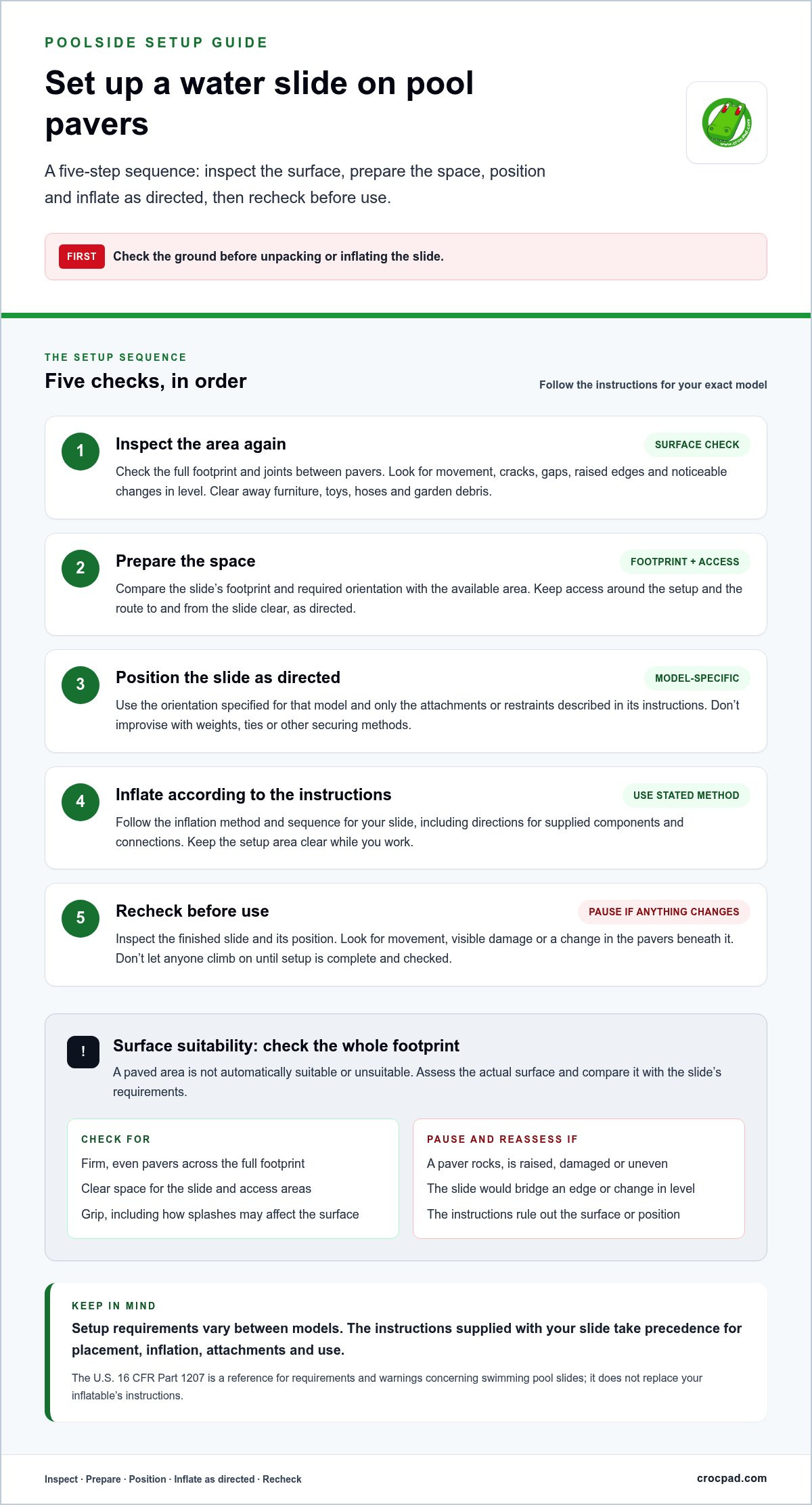
- Inspect the area again. Before unpacking, make sure the footprint is clear and the pavers haven’t shifted or become obstructed. Move furniture, toys, hoses and garden debris that could get in the way during assembly or use.
- Prepare the space. Compare the slide’s footprint and required orientation with the available area. Leave access around the setup as directed and keep the route to and from the slide clear. Don’t begin if the product instructions rule out the surface or available space.
- Position the slide as directed. Set it in the orientation specified for that model. Use only the attachments or restraints described in its instructions. Don’t improvise with weights, ties or other securing methods.
- Inflate according to the product instructions. Use the stated inflation method and sequence for that model. Follow directions for the supplied components and connections rather than assuming another slide uses the same process. Keep the setup area clear so you can spot a problem before anyone enters it.
- Recheck before use. Follow the supplied checks and inspect the finished slide and its position. Look for movement, visible damage or a change in the pavers beneath it. If the slide moves, a paver shifts or anything doesn’t match the instructions, pause before play.
The U.S. 16 CFR Part 1207, Safety Standard for Swimming Pool Slides is a reference for requirements and warnings concerning swimming pool slides. It doesn’t replace the instructions supplied with your inflatable, which should guide its setup and use.
Keep the setup area clear throughout assembly and use. If people, pool gear or loose items enter the work area, pause until you can continue without obstruction. This makes it easier to follow each step and notice changes as they happen.
If you’re comparing models for your poolside setup, Crocpad inflatable pool slides include options to consider. Follow the instructions for the model you choose. A methodical sequence is central to how to set up water slide on pool pavers safely: inspect, prepare, position, inflate as directed, then recheck.
Are pool pavers safe for a water slide? Check these conditions
Pool pavers aren’t automatically suitable or unsuitable for an inflatable slide. The decision depends on the condition and layout of the area, as well as the slide’s instructions. A tidy-looking surround may still have a loose paver or uneven section beneath part of the footprint. Assess the actual setup, not just the general appearance of the poolside.
When the paved area may be suitable
A potentially suitable spot is firm underfoot, even across the full footprint and clear of loose objects. The slide should fit in its instructed position without straddling awkward edges, and the surrounding area should allow for the setup and intended use. The product instructions must also permit that surface and placement.
Look beyond the centre of the footprint. Changes in level near the edges may affect how the slide rests or fits. Also consider that splashes can make pavers wet, so a dry inspection alone won’t show how the surface may feel during use.
When to stop and reconsider the setup
Reassess if you find pavers that move, are cracked or raised, or create a noticeable uneven section. Do the same if the slide would cross an awkward edge, extend beyond the available area or leave too little clear space around it. These conditions are reasons to check the location carefully, not to assume it’s suitable.
Pay attention once the slide is positioned. If it moves or a paver shifts, stop and don’t use that setup. Don’t try to fix the issue by changing the slide’s position or adding a restraint unless the model’s instructions allow it. If you can’t follow the directions on the available surface, choose a different setup rather than improvising.
For broader context, ASTM International publishes ASTM F2376 Standard Practice for Water Slide Systems, which addresses water slide systems. Treat it as general reference material, not a substitute for the instructions supplied with an inflatable slide. The model-specific directions should guide your decision about the paver layout.
Decision rule: if the pavers are unstable or uneven, the layout doesn’t fit, or the instructions raise doubt about the surface or position, don’t use that setup. Reconsider the location and review the product guidance before proceeding. This keeps how to set up water slide on pool pavers safely grounded in the conditions at your pool, rather than a blanket yes-or-no answer.
Before anyone climbs on: complete a poolside pre-use check
Setup isn’t finished just because the slide is inflated. Before play, check where the slide meets the pavers, then inspect the surrounding space and review any model-specific instructions. Water, foot traffic or small changes during setup can affect the area, so don’t rely only on your first inspection.
Inspect the slide, pavers and poolside space
Walk around the setup and compare the slide’s position with the placement shown in its instructions. Check that it hasn’t shifted and that the pavers beneath and beside it still appear stable. Look over the visible parts of the slide for damage or changes since assembly. Don’t correct a concern by moving or securing the slide in a way the instructions don’t describe.
- Position: Confirm the slide remains in its instructed orientation and hasn’t moved.
- Pavers: Look for a paver that has shifted, lifted or changed position since your earlier assessment.
- Visible condition: Check for damage or an unexpected change to the slide before use.
- Clear access: Remove toys, loose pool equipment and other obstacles from the intended access and exit areas.
- Water supply: If the model uses a water supply, follow its instructions for setup and operation. Don’t improvise a connection or route a hose where it obstructs access.
Check the setup in its ready-to-use state. If water is about to be turned on, follow the product guidance for that step and make sure the paver interface and access areas remain clear. Don’t assume an earlier inspection accounts for changes during setup.
Supervise play and respond to movement
Follow the product instructions for supervision and use throughout the activity. A responsible adult should actively supervise the pool area, stay attentive and be ready to respond if the setup changes. Keep an eye on the slide’s position and surrounding pavers, particularly when splashing makes the surface harder to see.
Stop play if the slide shifts or the surface changes. Have everyone leave the slide, then reassess the setup and follow the model instructions before considering use again. Stop if a paver moves, an obstacle enters an access or exit area, visible damage appears, or the water-supply setup no longer matches the directions. Don’t continue while a concern remains unresolved.
This final check is a practical part of how to set up water slide on pool pavers safely. Keep the guidance for your specific slide close at hand. Crocpad pool slides include options to consider for a poolside setup.
Choose a Crocpad inflatable slide and follow its setup guidance
Once you’ve assessed the poolside area, use what you found to guide your slide choice. Consider the available space, the intended position and the route around the slide. Then read the setup guidance for the exact model you’re considering. A product name alone can’t tell you whether a particular paved layout meets its requirements.
Match the slide choice to your poolside setup
Picture where the slide would sit in relation to the pool and surrounding pavers. Consider the full footprint, its intended orientation and whether the layout leaves room for the access and exit areas described in the instructions. If the preferred position crosses an uneven join or leaves little clear space, factor that in before choosing a model.
Use the model’s instructions to understand its requirements for surfaces and placement. Don’t assume guidance for one inflatable slide applies to another, or that a paved surround is suitable simply because it looks level. Check whether the actual area you plan to use matches the requirements for the specific slide.
Make product selection part of setup planning, rather than waiting until the slide is unpacked. Compare the available poolside space with the model guidance first. If you can’t follow the instructions in the intended position, reconsider the layout or your slide choice before proceeding.
Explore Crocpad pool slide options
Crocpad offers the Minima Pool Slide, the Mikros Pool Slide and the Megalo 3M Inflatable Water Pool Slide. Consider these options alongside your available poolside space and intended placement. Check each model’s setup guidance against the area you plan to use.
When reviewing a model, base your decision on its supplied instructions, the space available and whether the proposed placement follows those directions. This is more useful than guessing from a product name or appearance, and helps you plan the setup and pre-use checks.
The same approach applies if you’re still working out how to set up water slide on pool pavers safely. Decide on the intended position, check the pavers and surrounding clearance, then follow the guidance for the exact model you select. Crocpad inflatable pool slides are available to explore as you plan your poolside setup.
Make your next poolside setup a confident one
A water slide should fit your poolside space, not force you to compromise on the setup. Before choosing a slide, consider where it will sit and whether its instructions align with the paved area available. That gives you a practical starting point for deciding how to set up water slide on pool pavers safely, with the product guidance shaping your plan from the outset.
Keep that connection in mind as you explore your options. Crocpad’s inflatable pool slide range includes models to consider, while each slide’s instructions guide its setup. Choose with your space in mind and prepare the area before play.
Crocpad inflatable pool slides are a place to start when planning your poolside setup.
Frequently Asked Questions
Can you set up an inflatable water slide directly on pool pavers?
Sometimes, but only if the pavers and the slide’s instructions suit the planned setup. For how to set up water slide on pool pavers safely, don’t assume a hard surface is automatically appropriate. Check the instructions for the exact model and consider how splashes may affect the surface. If the directions don’t allow your intended placement, choose another setup that follows them.
Do you need a mat under a water slide on pavers?
Use a mat only if the slide’s instructions call for or allow one. A mat might seem like an easy way to protect the slide or cover paver joints, but it could affect how the base sits or interacts with the surface. Don’t add an unapproved layer or use it to compensate for uneven pavers. Follow the model guidance for any underlay or protective material.
Should pool pavers be wet before setting up an inflatable slide?
Don’t wet the pavers as a setup step unless the product instructions specifically direct you to. A dry area makes it easier to inspect the surface and notice changes during placement. If the pavers are already wet, consider whether the reduced grip affects the setup area and follow the slide’s guidance. Don’t begin if wet conditions make it difficult to position or inspect the slide as directed.
Can an inflatable slide sit near pool coping?
Only if the model’s instructions permit the position and the slide can sit as directed without bridging an edge or resting awkwardly against the coping. Check the complete footprint, not just the part nearest the pool. If the coping or a change in level affects the placement, don’t force the slide into that spot. Choose a position that follows the product guidance.
What should you do if a pool slide moves on pavers?
Stop play straight away and have everyone get off the slide. Don’t push it back into place while people are using it or add improvised restraints. Once the area is clear, follow the model’s instructions to assess what changed and whether the setup can be corrected as directed. If a paver has moved or the issue remains, keep the slide out of use until it’s resolved.
How do you check whether pool pavers are stable enough for a slide?
Inspect the planned footprint, including the joints and edges, and look for pavers that rock, lift or shift under ordinary foot pressure. Compare the whole area with the space and placement requirements in the slide instructions. A visual check can flag obvious concerns, but it can’t establish suitability if the instructions say otherwise. If you’re uncertain about the surface, don’t use that setup.
Explore Crocpad inflatable pool slides and compare the available models with your poolside space and setup requirements.


