

Weight alone won't keep an inflatable slide planted once splashing water reduces poolside friction to near zero. Every Aussie parent knows the gut-drop feeling of an unexpected afternoon wind gust catching a tall inflatable, bending flimsy plastic pegs and dragging the base across the paving. Finding the right wind anchoring kit for backyard pool slide setups is the only reliable way to lock down your gear on grass, pavers, or poured concrete without drilling permanent holes.
You shouldn't have to spend sunny weekends stressing over slide tip-overs or damaged seam stitching while the kids play. Discover how to choose the right wind anchoring setup to keep your backyard inflatable pool slide stable, safe, and secure throughout the hottest months. In this 2026 buying guide, we break down essential ballast strategies, heavy-duty tether requirements, and damage-free tie-down methods built for active Aussie backyards.
Key Takeaways
- Understand how tall inflatables act like sails in sudden gusts, and why dedicated tethering is essential to protect structural seams from heavy lateral strain.
- Discover why choosing the right wind anchoring kit for backyard pool slide setups requires high-tensile webbing straps and 316-grade marine hardware rather than elastic bungees.
- Compare surface-specific tie-down solutions, from screw-in ground anchors for grass to weighted ballast bags that protect pavers and concrete without drilling holes.
- Learn the professional rigging sequence that secures primary ground anchors before reaching full inflation pressure to achieve a balanced, rock-solid hold.
- Master quick pre-swim hardware audits and freshwater rinse routines to prevent saltwater or pool chlorine corrosion and extend gear lifespan.
Why Your Inflatable Pool Slide Needs Dedicated Wind Anchoring
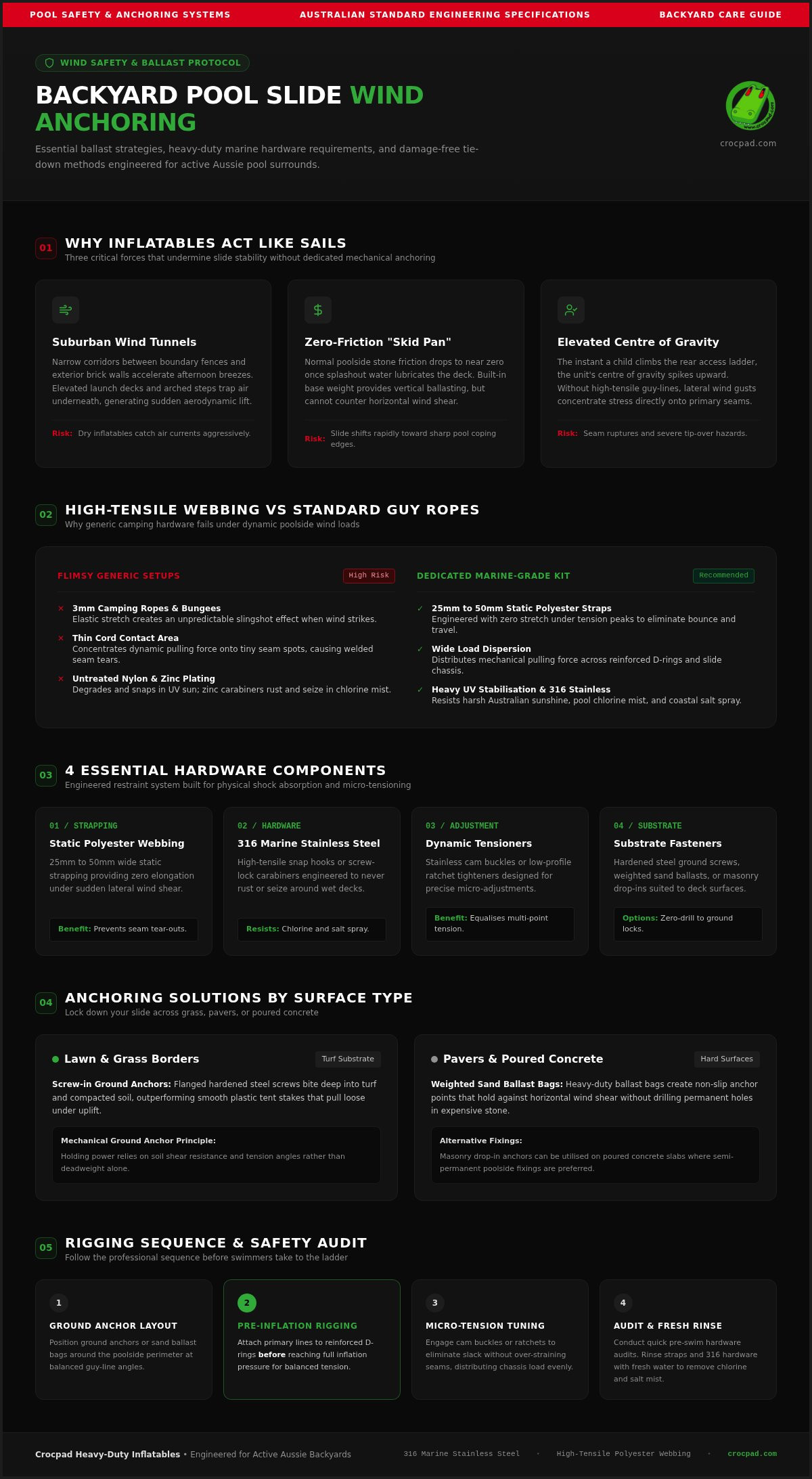
High-profile water slides deliver massive backyard fun, but their tall, broad surfaces act precisely like maritime sails when unexpected wind strikes. A proper wind anchoring kit for backyard pool slide setups is not just an optional accessory; it is a specialised restraint system engineered to counter intense lateral forces. Built-in water bladders or factory base weights provide vertical ballasting, yet they cannot neutralise sudden horizontal wind shear. When an unsecured slide shifts on slick pavers, it slides directly toward hard coping edges, putting climbers and swimmers at serious risk while abrasive concrete grinds down the protective PVC base.
Relying on generic tent pegs around a pool simply doesn't work against severe uplift forces. Understanding mechanical ground anchor principles reveals that holding power depends entirely on tension angles and substrate resistance rather than simple deadweight.
To see how poolside structures demand precise stability and secure footing, watch this assembly overview:
The Aerodynamics of Backyard Pool Slides
Inflatable slides capture moving air in ways standard flat mats never do. Arched access steps and elevated launch decks trap ambient air beneath their profiles, generating aerodynamic lift. In suburban Aussie backyards, narrow corridors between boundary fences and exterior brick walls create concentrated wind tunnels that accelerate afternoon breezes. Interestingly, bone-dry inflatables catch these air currents far more aggressively than thoroughly saturated units, as water sheeting adds temporary mass and disrupts smooth airflow across the slide vinyl.
Preventing Accidents and Equipment Damage
An inflatable becomes dangerously unstable the moment a child climbs the rear ladder, dramatically raising the unit's centre of gravity just as a gust hits. Without high-tensile guy-lines pulling equal tension against reinforced D-rings, violent gusts concentrate stress directly onto primary structural seams. Water splashout lubricates poolside stone, transforming normal deck friction into a frictionless skid pan. Installing a dedicated wind anchoring kit for backyard pool slide protection preserves seam longevity, prevents severe tip-overs, and keeps your slide rock-solid all summer long.
Key Components of a Heavy-Duty Wind Anchoring Kit
Locking down a multi-metre slide requires purpose-built engineering, not thin camping strings or stretchy elastic bungees. A high-performance wind anchoring kit for backyard pool slide setups relies on integrated, non-stretch tension systems designed to handle dynamic physical shock loads. When selecting your hardware, focus on four fundamental components:
- Static Webbing: Wide polyester straps that deliver zero stretch under sudden tension peaks.
- Marine Connecting Hardware: High-tensile clips engineered to endure chlorine mist and salt air without seizing.
- Dynamic Tensioners: Stainless cam buckles or low-profile ratchet tighteners for micro-adjusting tension.
- Substrate Fasteners: Hardened steel ground screws, weighted sand ballasts, or masonry drop-ins suited to your deck.
Pairing these components with rugged, built-in anchor points on heavy-duty commercial-grade inflatables from Crocpad ensures every line distributes mechanical loads safely across the chassis.
High-Tensile Strapping vs Standard Guy Ropes
Standard 3mm camping ropes and elastic cords stretch excessively under load, creating an unpredictable slingshot effect when wind strikes. In contrast, 25mm to 50mm static polyester webbing delivers high tensile strength with minimal elongation. Wide straps disperse dynamic pulling force across a broader surface area, preventing concentrated friction tears at welded seams. Heavy UV stabilisation treatment is mandatory; untreated nylon quickly degrades and snaps under blistering Australian summer sunshine.
Corrosion-Proof Marine Hardware
Standard zinc-plated or galvanised steel carabiners fail rapidly around wet pool decks, developing surface rust that stains pavers and locks spring gates open. Demand 316 marine-grade stainless steel snap hooks or screw-lock carabiners instead. Inflatable slides experience rapid, multidirectional shifts during active play, so spring-loaded or locking gates are critical to stop tie-down loops accidentally jumping free under cyclical load variations. For robust residential installations, verify that all load-bearing connection hardware carries an adequate working load rating suited to sudden wind peaks.
Comparing Anchoring Systems Across Pool Surround Surfaces
Every backyard features distinct ground conditions, meaning one universal fastener cannot work everywhere. Choosing an effective wind anchoring kit for backyard pool slide stability means tailoring your rigging method to the exact substrate framing your water. Whether positioning a high-energy slide like the Mikros, Minima, or Megalo 3M Inflatable Water Pool Slide on lush turf, sandstone paving, or timber decking, your tethering must lock the unit down without wrecking your landscaping.
Turf and Soil Anchoring Solutions
Smooth metal stakes pull free easily when wet soil loosens. Spiral earth augers screw deep into firm dirt, using helix flighting to distribute mechanical resistance across a wide underground column. For maximum resistance, drive screw stakes at a 45-degree angle leaning away from the slide pull direction. Always cap exposed metal heads with bright rubber covers to prevent stubbed toes on active pool lawns.
Paving, Tile, and Concrete Solutions
Drilling permanent holes into expensive travertine or porcelain tiles is rarely practical for residential setups. Non-invasive ballast bags made from commercial-grade, puncture-resistant PVC provide heavy ballasting without surface scratches. When choosing ballast, dry sand provides roughly 1.6 times the density of pool water, delivering superior deadweight in a compact footprint. For dedicated concrete aprons where drilling is permissible, spring-loaded brass drop-in anchors screw down flush with paving stones when unrigged.
Timber and Composite Decking Clamps
Timber surrounds allow clever tethering without driving a single screw into expensive boards. Fishbone spring anchors slide directly between decking gaps, rotate 90 degrees, and lock flat against the underside of the planks. Position these anchors directly adjacent to underlying support joists to prevent board flexing under dynamic tension. Always slip dense rubber buffer pads beneath metal clamp bodies to prevent unsightly gouges on treated timber or composite surfaces.
- Turf & Garden Beds: 300mm+ steel spiral augers angled at 45 degrees.
- Stone & Pavers: 25kg+ dry-sand heavy PVC ballast bags per tether point.
- Concrete Slabs: Retractable flush-mount brass anchors or external weighted ballasts.
- Hardwood & Composite Decks: Between-board spring anchors seated over structural joists.
Deploying surface-matched hardware keeps your wind anchoring kit for backyard pool slide setups performing safely across diverse outdoor spaces.
Step-by-Step Installation: How to Rig Your Slide for High Winds
Locking down high-profile inflatables requires a clear sequence. Trying to secure an already-inflated unit during an unexpected gust is dangerous and frustrating. A properly rigged wind anchoring kit for backyard pool slide security relies on staged inflation, letting you anchor the frame before wind can catch underneath it.
Strategic Placement and Wind Orientation
Assess your yard's airflow patterns before unrolling any vinyl. Angle the rear access steps away from dominant afternoon seabreezes to reduce frontal drag against the tall slide face. Maintain at least a 1.5-metre buffer zone around ladder entry points, and keep guy-lines angled away from high-traffic poolside walking paths to prevent barefoot trips.
Balancing Multi-Point Tension
Position anchor straps at 45-degree angles from the slide body to balance downward hold with lateral resistance. Tighten opposing cam straps gradually in an alternating sequence rather than cranking one side down completely, which distorts internal baffling. Remember that midday Australian sun heats trapped air inside the chambers; this naturally expands the PVC and increases strap tension, requiring a quick midday slack adjustment.
Follow this field-tested rigging sequence every time you set up:
- Step 1: Base Placement. Position the uninflated slide on your selected deck surface and connect lower perimeter tether points loosely to ground fasteners or sandbags.
- Step 2: Staged Inflation. Inflate the main chambers to roughly 70 percent capacity so the structure takes shape without catching excess wind.
- Step 3: Upper Tethering. Clip 316 stainless carabiners onto the upper reinforced D-rings, running static webbing down to your perimeter anchors.
- Step 4: Final Pressure. Complete full inflation to firm operational pressure, ensuring internal baffles are rigid.
- Step 5: Sequential Tensioning. Work around the perimeter, tightening straps evenly until the slide stands plumb without leaning toward any corner.
- Step 6: The Manual Pull Test. Grip the mid-frame firmly and pull hard in two directions. If the base lifts or shifts on the pavers, retighten your ballast lines immediately.
Ready to level up your summer pool setup with heavy-duty inflatables built for serious action? Browse premium pool slides at Crocpad and build a safe poolside playground today.
Maintenance, Safety Audits, and Premium Inflatable Care
Rigging tough hardware is only half the battle. Even the highest-spec wind anchoring kit for backyard pool slide setups requires ongoing care to perform reliably against sudden coastal gusts. Sun exposure, mineral-rich pool splashout, and active playtime generate steady wear and tear. Running a quick two-minute hardware audit before every swim session protects your investment and keeps backyard entertainment completely worry-free.
Routine Hardware and Strap Inspections
Check all high-stress stitching patterns along the strap loop joins before hooking up your lines. Look closely for pulled threads, stiffened webbing from sun baking, or edge fraying caused by sharp paving stones. Depress every carabiner gate and cam buckle trigger to verify the internal springs snap closed instantly without sticking. Salt crystallisation and dried chlorine build-up are notorious for seizing moving metal parts, so rinse all straps and stainless connectors under fresh tap water after swimming. Allow webbing to dry completely in the shade before packing it into a dedicated storage bag away from direct sunlight.
Operational Safety Guidelines and Weather Limits
Heavy-duty tethers dramatically increase stability, yet no anchoring setup replaces good old-fashioned common sense. Operating inflatables in sustained winds exceeding 24 to 32 km/h (15 to 20 mph) poses serious risks, and units must be evacuated immediately if severe afternoon gusts hit. Keep a sharp eye out for early warning signals during play:
- Platform Oscillation: Noticeable side-to-side sway when kids reach the top ladder rungs.
- Corner Lifting: Daylight appearing beneath any base corner despite full ballasting.
- Guy-Line Vibration: Straps humming loudly or vibrating under severe aerodynamic tension.
- Seam Puckering: Excessive stretching or distortion around welded D-ring anchor patches.
When you spot any of these indicators, get everyone out of the pool zone and pull the rapid-deflation valves immediately. Combining proactive weather monitoring with commercial-grade engineering keeps your family safe across every hot summer afternoon. Explore premium inflatable slide designs by visiting Crocpad today, and lock in durable poolside gear engineered for real Australian backyards.
Lock Down Your Poolside Setup for Worry-Free Summer Fun
Summer afternoons shouldn't be spent stressing over unexpected coastal gusts. Choosing the right wind anchoring kit for backyard pool slide stability protects structural seams, prevents dangerous slide shifts, and keeps energetic splash sessions completely secure. Pairing zero-stretch static webbing with 316 marine-grade hardware ensures your rig holds firm, whether you're securing spiral augers into turf or positioning heavy sand ballast bags across delicate pavers.
True peace of mind begins with commercial-grade reinforced materials engineered for demanding Australian outdoor conditions. As a trusted national supplier of premium floating mats and water slides, Crocpad builds watercraft and play gear tough enough for vigorous backyard adventures. Lock down your setup with confidence and explore heavy-duty pool slides and water gear at Crocpad today.
Frequently Asked Questions
Can I use standard camping tent pegs to anchor a pool slide into grass?
No, standard camping pegs lack the holding power required for large pool inflatables. Smooth aluminium or plastic stakes pull straight out of soft, waterlogged soil when wind catches the slide platform. Instead, use commercial spiral earth augers that screw deep into the turf. These mechanical anchors distribute tension throughout an entire soil plug, giving your wind anchoring kit for backyard pool slide setups the grip needed to prevent sudden lift.
How do I secure an inflatable pool slide if I cannot drill into my pavers?
Use heavy-duty, puncture-resistant PVC ballast bags filled with dry play sand. Position these bags around the slide perimeter, clipping them directly to your tie-down points using static webbing straps. Sand offers significantly more density than water, providing immovable ballast without scratching or cracking your paving stones. Never tie straps to loose poolside furniture or light decorative fencing, as dynamic gusts can drag them across the coping.
What is the maximum wind speed safe for using an inflatable pool slide?
Inflatables should never be operated in sustained winds or gusts exceeding 24 to 32 km/h (15 to 20 mph). Even when properly tethered, sudden wind shear alters rider trajectory and exerts intense pressure against welded structural joins. If local forecasts warn of gusty afternoon conditions, or if you notice the slide platform swaying visibly, evacuate the kids immediately and open the rapid-deflation valves until calmer weather returns.
Will chlorine and pool salt corrode my wind anchoring kit hardware?
Yes, standard zinc-plated or mild galvanised hardware will corrode rapidly when exposed to chlorinated pool splashout and salty breezes. Always equip your wind anchoring kit for backyard pool slide stability with 316 marine-grade stainless steel carabiners, D-rings, and cam buckles. To maximise working life, rinse every metal clip and webbing strap under fresh tap water after heavy weekend use to wash away aggressive salt crystals and chemical residues.
How much weight is needed to hold an inflatable pool slide in place?
Most residential pool slides require at least 25 to 50 kilograms of ballast per anchoring point to counter lateral wind loads effectively. Depending on slide height, you should establish four to six independent perimeter tie-down points. Distributing this weight across multiple tether angles prevents concentrated stress on any single seam, keeping the unit stable on slippery, wet pool surrounds during active play sessions.
Should I leave my pool slide anchored outside all summer long?
It is best practice to deflate and store your slide when it won't be used for several days. Prolonged outdoor exposure leaves inflatables vulnerable to severe UV degradation, heat expansion, and unmonitored overnight storms. Deflating the structure between weekends preserves seam integrity, keeps tether webbing strong, and ensures high-profile gear remains protected from unexpected gale gusts when nobody is home to supervise.
How do I attach anchor straps to an inflatable slide without built-in D-rings?
You should never use high-profile pool slides that lack reinforced tie-down points. Tying ropes around handles or water-fill valves will rip seams apart under wind load. If your inflatable lacks factory anchor rings, you can install heavy-duty PVC D-ring patches using commercial vinyl adhesive. However, purchasing high-grade inflatables like Crocpad slides ensures multiple welded, reinforced tie-down points are already built directly into the chassis.


