

A firm-feeling surface isn’t automatically the right fit for your lake plans. With a rigid drop stitch floating platform for lake use, construction can influence how the platform feels underfoot, but it won’t tell you everything about stability, durability or safe use. Compare the details you can verify with your intended activities and the manufacturer’s instructions.
If platform specifications are hard to compare, start with how each product is made. Drop-stitch construction uses internal threads to connect the upper and lower surfaces. When inflated, that structure creates a firmer shape than many conventional inflatables. But firmness alone doesn’t show how a platform will perform with your group, gear or lake conditions.
This guide explains how the construction works and what to check before buying: dimensions, stated load limits, inflation requirements, materials, care instructions and anchoring options. You’ll also learn how solid-top platforms differ from mesh-centre styles, and why it’s worth checking lake rules and conditions before heading out. Use the details to compare like with like, identify unanswered questions and decide whether this style suits the way you want to enjoy the water.
Key Takeaways
- Understand what “rigid” means in a rigid drop stitch floating platform for lake use, and what it doesn’t tell you about performance.
- Compare drop-stitch, air-chamber and foam-style mats by how they’re constructed, stored and set up.
- Assess intended activities, stated user capacity and lake conditions as separate suitability checks.
- Use a practical checklist to compare dimensions, capacity, inflation guidance and included accessories.
- Review Crocpad’s Floating Water Mat as a related option, and confirm its current construction and specifications before comparing it with drop-stitch platforms.
What Is a Rigid Drop-Stitch Floating Platform for a Lake?
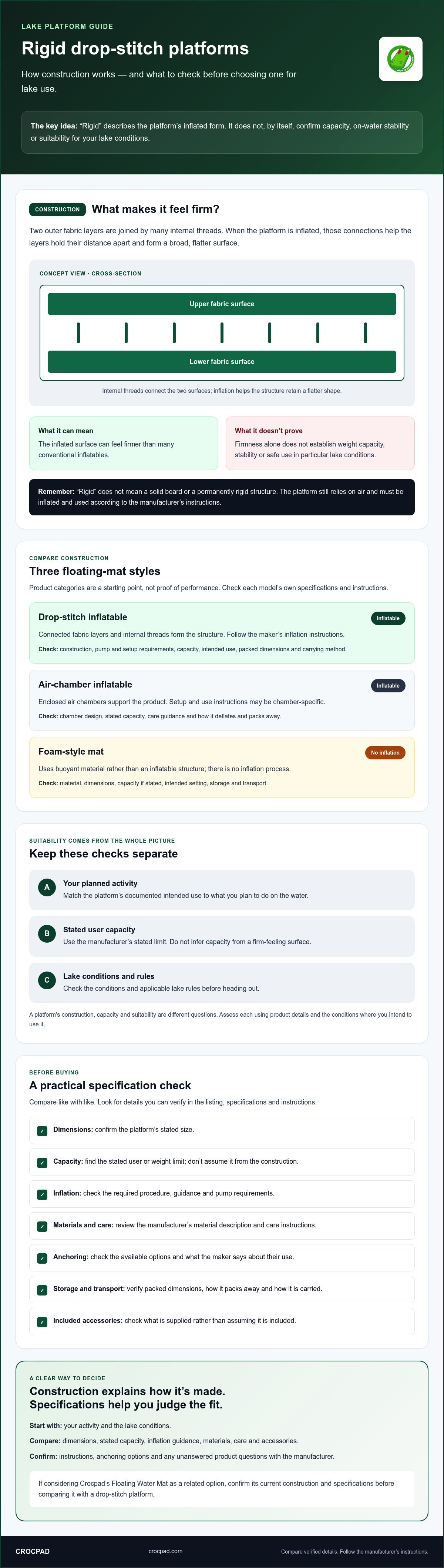
A drop-stitch platform is an inflatable structure made from two outer fabric layers joined by many internal threads. When inflated, those connections help the layers hold their distance apart, creating a broad, flatter surface rather than a simple rounded air chamber. Materials can vary between products, so check the manufacturer’s description for the model you’re considering.
Here, “rigid” describes the platform’s inflated form, not a solid board or permanently rigid structure. It still relies on air and must be inflated and used according to the manufacturer’s instructions. The term alone doesn’t confirm weight capacity, how stable the platform feels on the water or whether it suits your lake conditions. Those questions depend on the individual design and its stated specifications.
For a visual example of a drop-stitch floating platform, watch the video below. Use it to understand the general idea, not as a substitute for checking a product’s own specifications and instructions.
How does drop-stitch construction create a firm inflatable platform?
Internal threads link the platform’s upper and lower fabric surfaces. As air is added, these connections help the layers expand together and retain a flatter shape. That can make the inflated surface feel firmer than an inflatable formed only from separate air chambers, but it doesn’t guarantee a particular level of firmness. For background on materials and methods used in inflatable watercraft, see this overview of inflatable boat construction.
What does ‘rigid’ mean in a floating-platform listing?
It describes an intended quality of the inflated platform, not a promise that it behaves like a hard, solid deck. Firmness can vary with the design and the manufacturer’s inflation guidance. Read the product listing and instructions rather than treating “rigid” as proof of capacity, stability or suitability.
Before choosing a rigid drop stitch floating platform for lake use, start with your planned activity. Then match it to documented details such as dimensions, stated capacity, inflation requirements and use instructions. Construction explains how a platform is made; verified specifications help you judge whether that model fits your plans.
How Drop-Stitch Lake Platforms Differ from Other Floating Mats
Floating products can look similar in a listing but differ in how they’re made and prepared for use. A drop-stitch platform uses connected fabric layers and internal threads, an air-chamber inflatable relies on enclosed chambers, and a foam-style mat uses buoyant material rather than an inflatable structure. These differences affect what to check before heading to the water. They don’t, by themselves, prove a product is stable, puncture-resistant or suited to your lake.
Compare construction and setup
Compare practical details in each product’s instructions and specifications, not just its category label. An inflatable may need a pump and a particular inflation procedure, while a foam-style mat doesn’t require inflation. Packed size, carrying method, setup steps and intended use vary by product. Look for published details rather than assuming one type is easier to transport or prepare.
| Type | Inflation | Packed storage | Setup considerations | What to verify |
|---|---|---|---|---|
| Drop-stitch inflatable | Inflated according to the maker’s instructions | Check packed dimensions and carry method | Confirm pump and setup requirements | Construction, inflation guidance, capacity and intended use |
| Air-chamber inflatable | Inflated chambers support the product | Check how it deflates and packs away | Review chamber-specific setup and use instructions | Chamber design, stated capacity and care guidance |
| Foam-style mat | No inflation process | Check how it’s stored and transported | Review handling and use instructions | Material, dimensions, capacity if stated, and intended setting |
Match the construction to your plans
Consider where you’ll use the mat, what you’ll do on it, and how you’ll transport and store it. Compare those needs with the manufacturer’s stated use, dimensions and capacity. Don’t infer puncture resistance or on-water stability from “drop-stitch” or “foam” alone. If boating is part of your plans, the U.S. Coast Guard’s boating safety regulations provide a U.S.-specific reference. Check the guidance and local requirements relevant to your location and activity.
Crocpad offers a Floating Water Mat, but check its current product details to confirm its construction and specifications. Treat it as a related option to assess, not as a verified drop-stitch platform. You can review Crocpad’s Floating Water Mat and compare the published details with your requirements. For a rigid drop stitch floating platform for lake use, the product documentation is what lets you make a fair comparison.
Will a Rigid Drop-Stitch Platform Suit Your Lake Use?
The word “rigid” doesn’t guarantee that a platform suits your plans. Its suitability depends on what you’ll do on it, who’ll use it and whether the manufacturer permits use in your lake’s conditions. Assess each point separately. If a listing doesn’t answer an important question, don’t fill the gap with assumptions based on the construction label.
Start with the activity and users
Decide whether you want the platform for lounging, play, access or another activity. Check that the exact product is intended for that use. Read its stated user and load guidance, and consider how many people may be on it at once. Don’t assume a capacity claim supports every activity or arrangement of users. Follow the manufacturer’s wording and instructions.
Check the conditions where you’ll use it
Review the maker’s permitted water conditions and operating limitations. Wind, current, boat traffic and distance from shore can all affect your lake-use plans, so consider them when choosing where to use the platform. Check relevant local water-safety advice as well. No construction type guarantees safe use in every setting, and a listing may not cover every condition you’ll encounter.
Use this table as a cautious starting point. It doesn’t rate a specific model. Product-specific capacity, stability and environmental suitability details need to come from the manufacturer.
| Check | Potential advantage | Limitation to keep in mind |
|---|---|---|
| Intended activity | A suitable design may serve the activity described by its maker. | “Rigid” alone doesn’t establish permitted uses. |
| User and load guidance | Published limits can help you assess whether the product fits your group. | Without model-specific guidance, capacity can’t be assumed. |
| Lake conditions | Clear operating instructions help you judge whether the setting is appropriate. | General construction descriptions don’t confirm suitability for wind, current or boat traffic. |
Before choosing a rigid drop stitch floating platform for lake use, compare the activity, user count and lake setting with the exact product’s documented limits. Crocpad offers a Floating Water Mat, but its construction and specifications need to be checked in the current product details. Once you’ve set your criteria, you can review Crocpad’s Floating Water Mat as a related option and see whether its details meet your needs.
What to Check Before Buying a Drop-Stitch Floating Platform
Compare listings against the same checklist, separating confirmed specifications from details the seller hasn’t provided. A feature mentioned in a listing isn’t automatically included, and a construction label doesn’t replace product-specific instructions. If an important point is unclear, ask the seller before buying.
- 1. Confirm the construction. Check whether the manufacturer explicitly describes the platform as drop-stitch and identifies its materials. Don’t rely on a product title or marketing term alone to establish how it’s built.
- 2. Record the dimensions. Note the stated dimensions and compare them with the space and activities you have in mind. If packed dimensions are listed, record those as well to assess storage and transport needs.
- 3. Check stated capacity. Look for the manufacturer’s user or load guidance for the exact model. Don’t estimate capacity from the platform’s size, appearance or construction. Check that the guidance suits your intended use.
- 4. Read inflation instructions. Confirm the specified inflation method and follow the maker’s operating guidance. Don’t assume a particular pump is included or that inflation details are interchangeable between products.
- 5. Check what comes in the package. Look for an explicit list of included accessories, such as a pump, carry bag or repair kit. If the listing doesn’t say, confirm with the seller rather than treating an accessory as standard.
- 6. Review care and support. Find the product’s cleaning, drying, storage and repair instructions. Confirm the seller’s warranty terms and available support directly. Don’t assume coverage or repair help is included.
Turn the checklist into a fair comparison
Keep a simple record for each option using the same fields: construction and materials, dimensions, stated capacity, packed size, inflation method, included accessories, care guidance and warranty terms. Mark missing details as “not stated” rather than filling gaps with guesses. This makes it easier to identify which follow-up questions to ask before deciding.
Use this process to assess any rigid drop stitch floating platform for lake use against your plans. Crocpad offers a Floating Water Mat, but check its current listing for construction and specifications. Explore Crocpad’s Floating Water Mat and compare its product details against the same criteria you use for other options.
How to Choose Your Lake Platform and Explore Crocpad’s Floating Water Mat
Choose in three steps: define the activity, compare verified product details, then confirm care and support. This keeps your decision grounded in what you’ll actually do on the water, rather than a product label or appealing feature list. A rigid drop stitch floating platform for lake use is worth considering only if its documented limits and instructions fit your plans.
Make the final comparison
Start with the intended activity and the number of people who’ll use the platform. Check each manufacturer’s stated use and capacity for the exact model, then compare like with like. For example, compare published dimensions with dimensions, and stated packed size with packed size. If a listing omits a detail, mark it as unknown rather than assuming it matches another product.
Before you decide, make sure you can answer these questions from the product documentation or the seller:
- Does the stated use match your planned activity and lake setting?
- Are the user or load limits clear for the way you intend to use it?
- Do you understand the construction, inflation requirements and operating limitations?
- Are the included accessories, care instructions and storage guidance specified?
- Can you find the seller’s warranty terms and information about repair or support?
Ask the seller if construction, limitations or included equipment remain unclear. This is particularly useful when comparing different designs, since a similar name or appearance doesn’t mean products share the same specifications. Check that you understand how to care for the platform and where to find support before purchasing, not after your first outing.
Consider Crocpad’s Floating Water Mat
Crocpad is a premium recreational water-gear brand that offers a Floating Water Mat. Check the current product details to see whether it uses drop-stitch construction, is rigid when inflated or is rated for lake use. Until those details are clear, treat it as a separate option to investigate, not as a verified match for a drop-stitch platform.
Compare the current listing with the same criteria you use for other products. Check the construction, dimensions, stated capacity, intended use, care guidance and any included items. If a specification you need isn’t published, contact the seller to clarify it before making a comparison.
Ready to add it to your shortlist? Explore Crocpad’s Floating Water Mat and review its current details. Choose water gear that fits your plans, with clear product information behind your decision.
Choose with confidence, then get ready for the water
Judge a rigid drop stitch floating platform for lake use by more than its name. Drop-stitch construction explains how an inflatable platform is formed, but the product details determine whether it fits your plans. Match the manufacturer’s stated use and capacity to your activity, compare specifications on a like-for-like basis, and check inflation, care, storage and support information before buying.
Crocpad offers a Floating Water Mat. Check its current product details to verify its construction and specifications, then see whether they suit your requirements.
Ready to explore? Explore Crocpad’s Floating Water Mat and check the product information for yourself. Choose gear that fits your plans, then enjoy making the most of your time on the water.
Frequently Asked Questions
What is a rigid drop-stitch floating platform?
It’s an inflatable platform with two fabric layers connected by many internal threads. When inflated according to the manufacturer’s instructions, this structure can hold a flatter, firmer shape than a simple air chamber. “Rigid” doesn’t mean solid or permanently inflexible. Check the specific product’s construction, inflation guidance and intended use to judge whether its documented features match your plans.
Is a drop-stitch floating platform suitable for a lake?
It may suit some lake activities, but the product description alone can’t confirm suitability. For a rigid drop stitch floating platform for lake use, check the maker’s stated activities, user capacity, operating instructions and limitations. Consider the conditions where you plan to use it, including wind, current and boat activity. Follow the product guidance and relevant water-safety advice, and don’t treat a platform as a substitute for safe supervision.
Can you leave a drop-stitch platform inflated on the water?
Don’t assume it can be left inflated or unattended. Check the manufacturer’s instructions for use, storage, weather exposure and when to remove the platform from the water. Guidance can differ between products and conditions, so don’t apply a general rule to a particular model. If the instructions don’t clearly cover leaving it afloat or exposed for an extended period, ask the seller or manufacturer first.
How much weight can a drop-stitch floating platform hold?
Capacity depends on the specific platform, so use the manufacturer’s stated limit rather than a general estimate. Check whether the guidance gives a total load, a user count or both, and follow any conditions attached to those figures. Don’t estimate capacity from the platform’s size or construction. If the listing doesn’t provide clear information, contact the seller before buying or using it.
Are rigid drop-stitch platforms better than foam floating mats?
Neither type is automatically better for every buyer. Compare the products’ intended uses, dimensions, portability, storage needs and manufacturer guidance. An inflated drop-stitch platform’s firmer feel may suit some preferences, while another mat may fit different priorities. Assess verified specifications alongside your planned activity rather than choosing based on a construction label alone. Check product-specific instructions before relying on a feature or performance claim.
Does Crocpad sell a rigid drop-stitch floating platform for a lake?
Crocpad offers a Floating Water Mat, but check the current product listing to confirm whether it uses drop-stitch construction or is a rigid platform. Crocpad is an Australian recreational water-products brand. Review the listing or contact the business for confirmed construction and specifications before treating the mat as a match. Compare those details with your intended activity and lake-use requirements before deciding.


