

Did you know that 81 people drowned in Australian waterways between December 2025 and March 2026? While summer is for epic lake days and pool parties, those figures are a blunt reminder that water safety isn't optional. You want your family to have the time of their lives on your floating water mat, but it’s hard to relax when you’re worried about kids getting stuck underneath or the mat drifting away. Learning a few essential floating mat safety tips is the best way to swap that anxiety for pure, high-energy fun.
We agree that a secure setup is the foundation of every great adventure. This guide will help you master the essentials of water mat safety so you can ensure every splash is as secure as it is exciting. We’ll walk through the latest Consumer Goods Safety Standard 2026 requirements, the right way to use AS 4758-compliant lifejackets, and how to perfect your anchoring setup to keep your gear exactly where it belongs. You’ll also discover how to organise your gear to extend your mat’s life through smart, safe use.
Key Takeaways
- Learn why the "Six-Foot Rule" is the most critical factor for jumping safety and how to choose the correct anchor to stop your mat from drifting.
- Discover how to organise a "Water Watcher" rotation to maintain active supervision and ensure everyone stays within a safe distance of the shore.
- Master essential floating mat safety tips, including why AS 4758-compliant lifejackets are a non-negotiable requirement for children and weak swimmers.
- Identify how to spot foam fatigue and grommet wear early to prevent equipment failure during a high-energy lake day or pool party.
- Understand the safety benefits of high-visibility colours and marine-grade materials that can withstand the intense Australian sun and salt.
Why Floating Mat Safety is Non-Negotiable for Aussie Summers
A floating water mat is a high-buoyancy, marine-grade foam platform designed specifically for on-water recreation and relaxation. While it offers an incredible base for summer fun, it’s vital to remember it is a recreational toy, not a lifesaving device. Before the first person hits the water, set a "Safety First" culture. This mindset ensures everyone understands the rules and respects the water. Incorporating proactive floating mat safety tips into your routine prevents accidents before they start, keeping the focus on leisure and physical rejuvenation.
The "Aussie Factor" requires extra vigilance. Our intense UV levels can degrade inferior materials, while unpredictable tides and currents can turn a stationary mat into a moving hazard. New regulations, such as the Consumer Goods (Aquatic Toys) Safety Standard 2026, highlight the importance of physical safety properties in water gear. Following general water safety principles is the best way to ensure your season stays focused on fun. Choosing high-visibility gear from Crocpad makes it easier to keep track of everyone in the water, even from a distance.
The Difference Between Pools and Open Water
Pool safety doesn't always translate to the local dam or bay. In a pool, the environment is controlled and the bottom is flat. In open water, you have to manage submerged logs, snags, and sudden depth changes that aren't always visible. Coastal users must also account for tides and wind drift. A sudden gust can cause a mat to drift surprisingly fast, so always assess the conditions before you unroll your mat for the day.
Understanding Weight Capacity and Buoyancy
Calculate your "real-world" capacity carefully. It isn't just about the number of people; you must include the weight of Eskies, waterproof bags, and other gear. Overloading creates a submergence risk where the mat sits too low in the water, reducing stability. Look for mats made with cross-linked foam. This material is essential for longevity and structural integrity. It resists the harsh Australian environment and ensures the mat stays buoyant and flat, even when the play gets intense. If the edges start to dip under the surface, it’s time to reduce the load and re-establish balance.
Mastering the Environment: Anchoring, Depth, and Conditions
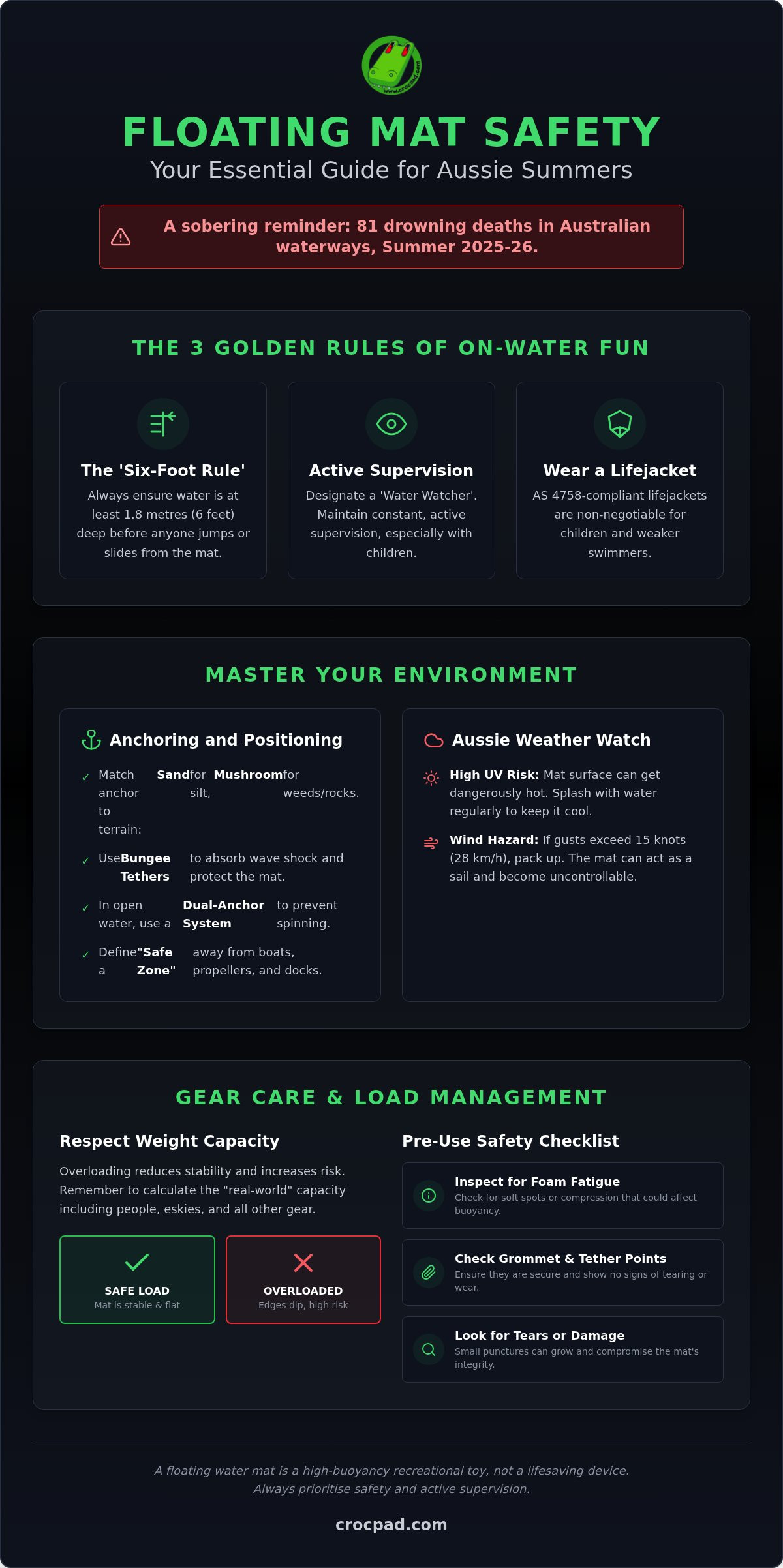
Securing your spot on the water requires more than just dropping a weight. The "Six-Foot Rule" is your primary defence against impact injuries. Always ensure the water depth is at least six feet before anyone starts jumping or sliding. This provides a safe buffer from the bottom and any hidden snags. For the best results, match your anchor to the terrain. Sand anchors work best for silty or sandy bottoms, while mushroom anchors are designed to grip in weedy or rocky lake beds. Using bungee tethers is another one of those essential floating mat safety tips that professionals swear by. These cords absorb wave energy, preventing the mat from jerking and protecting the foam from tearing at the tether point.
Positioning is everything when it comes to safety. Define a "Safe Zone" for your mat that stays well away from boat propellers, jet ski lanes, and busy docks. Staying informed about government water safety rules helps you identify local hazards and navigation requirements before you set up. If you are looking for a setup designed for these conditions, consider one of the premium floating mats built with integrated tethering systems.
Anchoring Strategies for Lakes and Bays
In open bays or large lakes, a single anchor often isn't enough. Use a dual-anchor system to prevent the mat from spinning like a compass needle in shifting winds. This keeps your tether lines taut and predictable. Ensure your lines are highly visible to other boaties; a floating buoy attached to the line can prevent accidental prop entanglements. If you are in tidal waters, check the tide charts. A mat anchored in deep water at high tide can easily end up grounded on sharp rocks just a few hours later.
The Impact of Australian Weather on Safety
The Australian sun creates unique risks that go beyond sunburn. On days with a high UV Index, the surface of a mat can become hot enough to cause skin irritation or surface burns. Regularly splash the mat with water to keep the temperature down. Wind is another critical factor. If gusts exceed 15 knots, your mat essentially becomes a giant sail. This can cause the anchor to drag or the mat to flip. Assign a "Water Watcher" to monitor changing weather. If the clouds roll in or the wind shifts, pack the mat away immediately to avoid "sailing" accidents that could pull the mat into dangerous channels.
The Golden Rules of Supervision and Personal Buoyancy
Active supervision is the heartbeat of a secure lake day. Even the most buoyant mat can't replace a pair of vigilant eyes. To prevent supervisor fatigue, implement a "Water Watcher" rotation. Every 20 to 30 minutes, swap the designated adult in charge. This keeps the supervisor fresh and ensures they aren't distracted by their phone or a conversation. It's one of the most effective floating mat safety tips for groups of any size.
Setting firm ground rules before the first splash creates a culture of respect for the water. No diving or head-first entries are allowed; you never know when a submerged object might shift. Prohibit swimming underneath the mat to eliminate the risk of entrapment. Finally, keep horseplay in check. High energy is great, but pushing and shoving can lead to unexpected falls into deep water. PFDs (Personal Flotation Devices) should be standard kit for all weak swimmers and children, regardless of how confident they feel on the foam.
Follow this 5-point safety briefing before every session:
- Verify Depth: Confirm you have at least six feet of clear water below the mat.
- Designate the Watcher: Clearly name the person responsible for supervision for the next block of time.
- Fit Check: Ensure all weak swimmers have secured their life jackets properly.
- Set Boundaries: Point out the safe swimming zone around the mat and away from boat lanes.
- Review Signals: Make sure everyone knows how to signal the "Water Watcher" if they feel tired or need help.
PFD Standards in Australia
Don't settle for "near enough" when it comes to flotation. Always choose life jackets that comply with Australian Standard AS 4758. These provide the specific buoyancy levels needed for our local conditions. For children, perform the "lift test" by pulling up on the jacket's shoulders. If it slides up toward their chin or ears, it’s too big and won't keep them safe. Inflatable armbands or "floaties" are recreational toys, not safety devices. They can easily puncture or slip off, so they shouldn't be used as a substitute for a certified PFD.
Pet Safety: Protecting Your Four-Legged Mates
Dogs are often the first ones on the mat, but they can tire rapidly in open water. Constant swimming to stay near the family is physically demanding. To prevent joint strain or exhaustion during boarding, use an Inflatable Dog Ramp. This specialised tool gives your pet a stable path back onto the mat or boat without the struggle of clawing at the foam. A dog life jacket is also a brilliant investment for any lake trip. It provides the extra lift your mate needs if they get tired, ensuring they stay buoyant and safe while you enjoy the sun.
Gear Care: How Maintenance Prevents Accidents
Your gear's longevity is directly tied to your family's security. A well-maintained mat performs predictably, while a neglected one can fail when you least expect it. Start every session by inspecting the tether point. Look for signs of foam fatigue, such as small cracks radiating from the grommet. If the grommet feels loose or the foam looks stretched, the mat is at risk of breaking free. Checking these high-stress areas is one of the most vital floating mat safety tips for anyone using their gear in open water.
The Australian sun is relentless, and UV damage is a silent gear killer. Over time, intense radiation makes marine-grade foam brittle and prone to snapping. If your mat feels crunchy or loses its flexibility, its structural integrity is compromised. Proper rolling and storage are also essential. Always roll the mat loosely and store it flat or on its end in a shaded area. Tight rolling or heavy weights placed on top can cause permanent curling, creating a persistent trip hazard the next time you unroll it on the lake.
Cleaning for Grip and Longevity
A dirty mat is a dangerous mat. Algae and pond scum build up quickly, turning your stable platform into a slippery hazard. Use only mild, eco-friendly soaps and a soft brush to clean the surface. Avoid harsh chemicals that can strip the protective UV coating. It's critical to let the mat dry completely before you pack it away. Moisture trapped in a rolled mat encourages mould growth, which ruins the grip and creates "hot spots" of decay. Regularly check for these softened areas where the foam has begun to break down, as they can lead to sudden tears during high-energy play.
Transporting Your Mat Safely
Safety starts on the road. When heading to the boat ramp, secure your mat tightly to your vehicle or trailer using wide cam-buckle straps. Narrow ropes can cut into the foam during transport. Once you’re on the water, remember the golden rule: never tow a foam mat behind a moving boat. The drag forces are immense and will likely rip the tether system right out of the foam. This doesn't just ruin your gear; it creates a massive hazard for other boaties. Always check for new punctures or tears after every trip to ensure your buoyancy remains at peak performance. If you need gear that stands up to the toughest Aussie conditions, check out the durable floating mats from Crocpad.
Choosing a Safety-First Mat: The Crocpad Difference
Visibility is your best friend when you’re out on the water. Crocpad mats are engineered with high-visibility colours that stand out sharply against the deep blues and greens of Australian lakes and bays. This isn't just a design choice; it’s a critical safety feature. It ensures boaties and jet skiers can spot your recreation zone from a significant distance, reducing the risk of accidental proximity. As an Australian-owned and designed brand, we understand our local conditions better than anyone. We build our mats from premium marine-grade foam that resists the relentless UV radiation that quickly makes cheaper, imported alternatives brittle and prone to snapping.
Choosing a mat designed for our environment provides the ultimate peace of mind. By prioritising high-performance materials and structural integrity, we ensure our gear naturally aligns with the most rigorous floating mat safety tips. Our integrated tethering systems are built to handle the stress of open-water anchoring, keeping your family secure while they play. Whether you are setting up a lake-side base or a bay-front playground, the robust build of a Crocpad ensures your focus remains on the adventure, not the equipment.
Design Features That Protect Your Family
Superior stability is the result of our advanced multi-layer foam technology. This specific construction offers exceptional puncture resistance, easily standing up to high-energy play and the sharp claws of pets. We’ve optimised the thickness of every mat to provide better stability in choppy conditions, preventing the foam from bucking or folding when the wind picks up. To protect your skin, we use a smooth edge finishing process. This eliminates the rough, abrasive edges found on lower-quality mats that often cause irritation and scrapes during a long day of climbing on and off the platform.
Next Steps for a Safe Summer
Preparation is the key to a stress-free season. Before your first outing, organise your gear and run through this essential safety checklist:
- Inspect the Foam: Look for any deep gouges or UV-related brittleness.
- Check Tethers: Ensure the bungee cords and grommets are under no signs of stress or fatigue.
- Verify Depth: Always scout your location for a minimum of six feet of water.
- Life Jacket Fit: Confirm that children have outgrown neither their jackets nor their swimming skills since last year.
If you find any wear and tear, don't risk it. You can find replacement tethers, heavy-duty anchors, and other safety accessories directly through our site to keep your setup in peak condition. Ready to upgrade your summer setup with gear you can trust? Explore the Crocpad Floating Water Mat range today and experience the difference that premium Australian design makes for your family’s safety.
Get Ready for Your Safest Summer Yet
Summer is about making memories that last a lifetime, and safety is the silent partner in every great adventure. You’ve now mastered the "Six-Foot Rule" for depth, the importance of a dedicated "Water Watcher" rotation, and why inspecting your gear for UV damage is non-negotiable. These simple habits transform a good lake day into a legendary one, giving you the confidence to push the limits of fun without the stress. It’s about creating a secure environment where kids and pets can play freely.
By following these floating mat safety tips, you ensure that every jump and splash remains worry-free. Our gear is built for the rugged Australian climate, featuring heavy-duty marine-grade foam that has been trusted by thousands of Aussie families. We prioritise structural integrity so you can prioritise your leisure and rejuvenation. Don't leave your security to chance when you're out on the water this season.
Secure your summer fun with a Crocpad Floating Water Mat today. Grab your sunscreen, round up the crew, and hit the water for a season of pure, high-energy excitement!
Frequently Asked Questions
Is it safe to jump onto a floating water mat from a boat?
Jumping onto a mat from a boat deck is not safe and should be avoided at all times. The force of the impact can cause the mat to slide out from under you, leading to serious injury or a collision with the boat hull. Mats are designed for play starting from the water level. Always enter the water first and climb onto the foam to ensure your landing is controlled and your family stays out of harm's way.
Do children need to wear life jackets while on the mat?
Children and weak swimmers should always wear a life jacket while using the mat. While the foam is highly buoyant, it is a recreational toy rather than a lifesaving device. Unexpected falls into the water can happen during high-energy play or if the mat is crowded. Using an AS 4758-compliant life jacket is one of the essential floating mat safety tips that provides total peace of mind for parents and supervisors during the summer.
Can a floating mat flip over in high winds?
A floating mat can flip over if the wind becomes too strong. These mats have a large surface area that can catch the wind like a sail, especially in gusts over 15 knots. A flipping mat can trap swimmers underneath or pull its anchor, creating a significant hazard. Always monitor the conditions and pack your gear away if the wind shifts or if the water becomes too choppy for safe, stable play.
What is the safest way to anchor a mat in a lake with a current?
The safest way to anchor in a current is by using a dual-anchor system with bungee tethers. Place one anchor upstream to hold the mat against the flow and a second anchor downstream to stop it from swinging. This keeps the platform stable and prevents it from drifting into boat lanes. Ensure your lines are clear of swimmers and visible to other vessels to prevent accidents while you are enjoying your day on the lake.
Is it safe to swim underneath a floating foam mat?
It is never safe to swim underneath a floating foam mat. The risk of entrapment or becoming disoriented is high, as the large surface area makes it difficult to find the edge for a quick breath. This is especially dangerous for children who might panic if they can't surface immediately. Always enforce a strict rule that no one goes under the mat, ensuring every swimmer remains visible to the designated supervisor at all times.
How do I know if my mat is too old to be used safely?
Your mat is too old to be used safely when the foam becomes brittle, shows deep cracks, or begins to flake off. These are clear signs of terminal UV damage that compromises the structural integrity of the gear. If the mat feels unusually heavy, it may be waterlogged and lose its buoyancy. Check the tether points regularly; if the grommets are pulling out or the foam is tearing, it is time for a replacement.
Can my dog’s claws damage the mat and cause it to sink?
Your dog’s claws won't cause the mat to sink. High-quality mats are made from closed-cell marine-grade foam, meaning the material stays buoyant even if it has surface punctures or scratches. While a high-energy pet might leave small marks on the surface, these are purely cosmetic and don't affect the flotation. For the best experience, use a specialised dog ramp to help your four-legged mate board the mat without needing to use their claws for grip.
What depth of water is required for safe use of a water mat?
Safe use of a water mat requires a minimum water depth of six feet. This depth provides a necessary safety buffer to prevent jumpers from hitting the bottom or striking submerged hazards like rocks and logs. Always check the depth across the entire area where the mat will sit. Following these floating mat safety tips ensures your family avoids impact injuries from hidden underwater snags as the tide goes out during the afternoon.


